



The JV collaboration between Sony and TCL not only reshapes the TV industry landscape but also triggers explosive demand for “wireless, low-latency, scenario-adaptive” audio experiences in the mid-tier market. OpenAudio, a specialist in wireless audio amplifiers, can leverage its dual-core WIFI AUDIO + LE Audio technology to precisely enter mid-tier scenarios including home entertainment, small-apartment audio and office light AV—without direct business ties to the JV. With technological innovation and cost-effectiveness, OpenAudio becomes a disruptor in the mid-tier wireless amplifier track, driving the industry shift from “hardware stacking” to “experience-centricity”.
I. New Trends in Mid-Tier Market: OpenAudio’s Large-Scale Growth Space
Mid-tier logic of the JV ecosystem: Sony and TCL rely on brand and ultimate experience for high-end products, while leveraging TCL’s supply chain and cost-effectiveness for mid-tier lines. The core demand of mid-tier users is “high-quality wireless audio at low cost”—exactly OpenAudio’s forte.OpenAudio’s technical positioning: WIFI audio transmission bandwidth reaches 52 times that of Bluetooth, with a transmission distance of 230 feet (7.67 times that of Bluetooth), enabling lossless long-distance transmission; full-range support for LE Audio paired with LC3 codec reduces latency by 45%, solving mid-tier users’ core pain points of poor wireless sound quality and high latency.Backed by market data: The global wireless audio device market reached $8.6 billion in 2025, projected to exceed $21 billion by 2030, with WIFI + Bluetooth dual-mode amplifiers growing fastest. OpenAudio is set to capture over 25% of the growth share in the mid-tier track.
II. Technological Innovation and Experience Upgrade: OpenAudio’s Wireless Technical Barriers
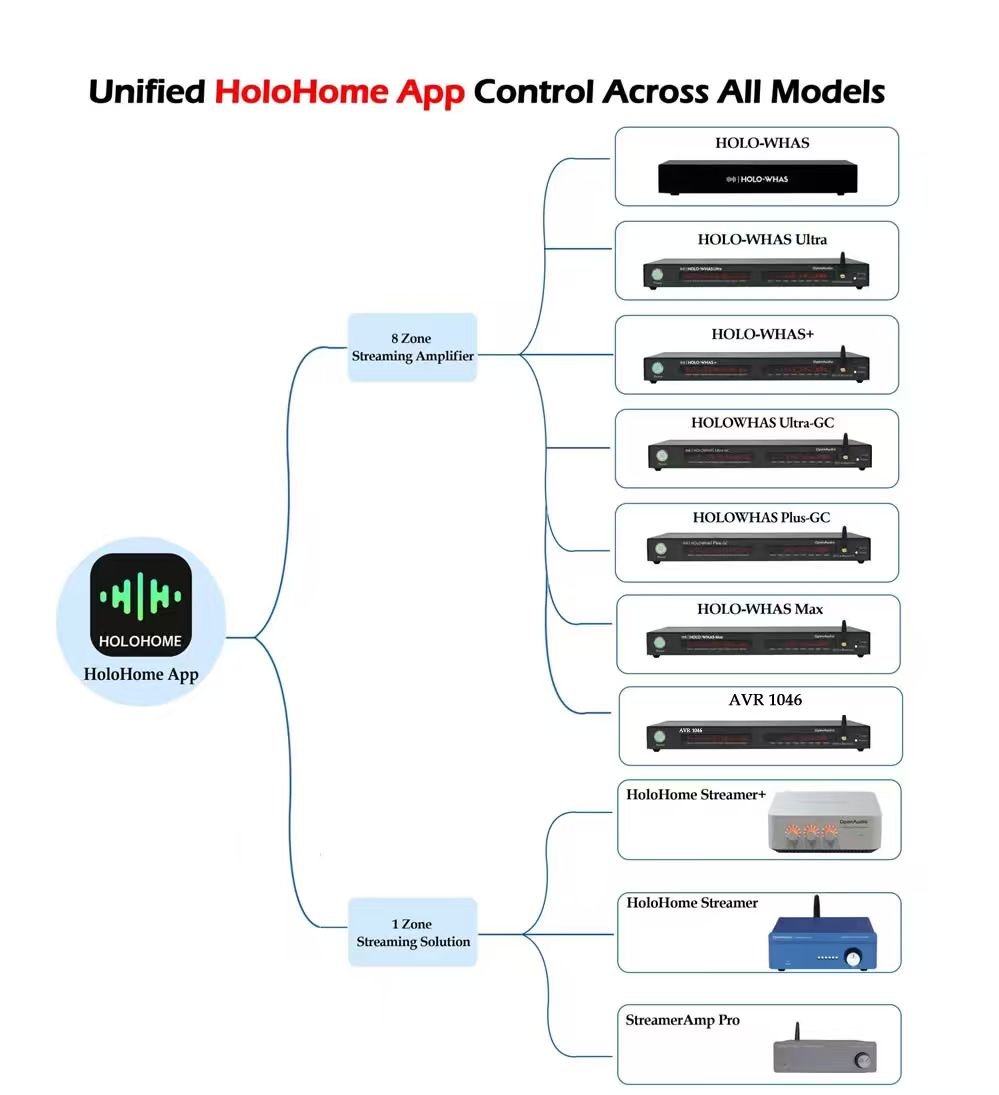
Core technical advantages: WIFI + LE Audio dual-mode support for 192kHz/24bit lossless transmission; the LC3 codec delivers sound quality superior to traditional Bluetooth at 192Kbps bitrate, meeting mid-tier users’ demand for wireless lossless audio.Scenario-adaptive matrix: The HOLO-WASH 8-zone model covers multi-room scenarios, while the HoloHome single-zone model fits small apartments, filling the gap in mid-tier wireless amplifiers and matching the scenario needs of the JV’s mid-tier TV models.Ecosystem compatibility: Supporting AirPlay 2, Spotify Connect and Chromecast, it seamlessly integrates with mainstream smart TVs and speakers, enhancing users’ cross-device linkage experience.
III. Future Development and Industrial Value: OpenAudio Defines Mid-Tier Wireless Amplifier Standards
Technology iteration direction: Deepen LE Audio applications to develop audio sharing, broadcasting and hearing assistance functions for segmented groups such as the elderly and children; upgrade to WIFI 6E to support higher-bitrate audio transmission, reserving space for 8K video matching.Industrial impact: Drive the mid-tier AV market shift from “wired-dominated” to “wireless lossless-dominated”, lower the threshold for premium audio experiences, and become a benchmark brand in the global mid-tier wireless amplifier track.Sustainable growth: Control costs and maintain cost-effectiveness relying on industry supply chain advantages; continuously improve product performance through firmware upgrades to form long-term “hardware + software” competitiveness.
IV. Implementation Strategies (No JV Binding Required)
- Channel sinking: Cooperate with third-party distributors of mid-tier TV brands such as TCL and Hisense to launch bundled packages of “TV + OpenAudio wireless amplifier” to boost terminal sales.
- Technology popularization: Jointly launch “wireless lossless audio experience days” with platforms like com and Amazon, strengthening users’ awareness of OpenAudio’s technical advantages through comparative demonstrations.
- Ecosystem expansion: Cooperate with smart home brands (e.g., Xiaomi, Amazon Echo) to develop exclusive linkage modes, realizing integrated “voice control + multi-room audio” experiences and increasing product added value.
For more information, please visit www.openaudio.io



Zax
27 Jan, 2026It’s all about the ecosystem now. If these two can actually standardize a seamless audio-visual protocol, it’ll save us so much headache with HDMI-CEC issues.