


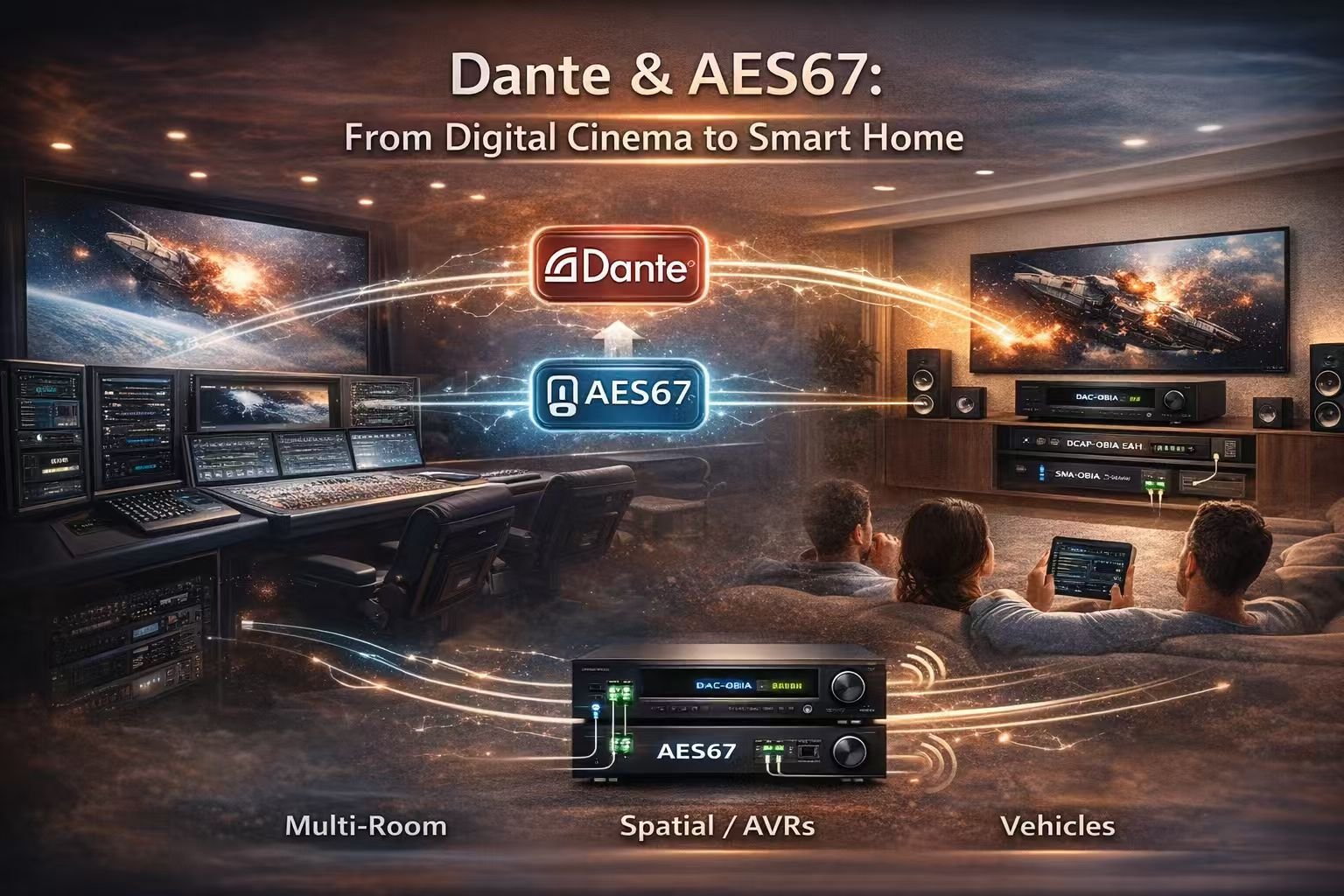
From Professional to Consumer:
Dante and AES67 Drive Smart Home Audio Innovation,
OpenAudio Seizes the Initiative with Technical Reserves
In the process of smart homes evolving from “single-product intelligence” to “whole-house intelligence”, the upgrading of audio systems has become a key breakthrough. Single-room speaker playback can no longer meet the needs of multi-zone linkage and immersive experiences, and Audio over IP (AoIP) technology based on IP networks is reshaping the industry landscape. Among them, the two major protocols, Dante and AES67, with their low latency, high stability, and high compatibility, have not only established a firm foothold in professional fields but also accelerated their penetration into smart homes, becoming the core support for future high-end audio-visual and whole-house audio ecosystems. OpenAudio, a company with years of deep cultivation in the audio technology field, relies on its profound technical reserves in Dante and AES67. Its DCAP-OBIA-EAH Digital Audio Processor, DAC-OBIA Digital Converter, and SMA-OBIA Digital Cinema Power Amplifier have long been widely used in digital cinema scenarios, verifying technical maturity. Now, it is achieving a technical breakthrough from professional scenarios to the consumer market, emerging as a core leader in the transformation of smart home audio.
I. Core Logic: Why Dante and AES67 Are Inevitable Choices for Smart Home Audio
The core pain points of smart home audio have always centered around three dimensions: “transmission efficiency”, “multi-device compatibility”, and “experience consistency”. Traditional audio relies on dedicated wiring, which not only has high transformation difficulty and cost but also cannot achieve precise synchronization and flexible networking across multiple rooms. Consumer-grade transmission protocols such as Bluetooth and Wi-Fi have problems such as high latency, sound quality loss, and unstable multi-device connections, making it difficult to support complex scenarios such as immersive audio-visual and whole-house voice interaction. The emergence of Dante and AES67 precisely addresses these industry pain points, and their technical characteristics are highly compatible with the needs of smart homes.
(1) Dante: The Ultimate Experience of a Proprietary Protocol, the Preferred Solution for High-End Scenarios
As a proprietary AoIP protocol launched by Audinate, Dante is the “de facto standard” in the professional audio field, with core advantages of low latency, high fidelity, and easy networking. Technically, Dante realizes uncompressed audio transmission based on UDP/IP, combined with IEEE1588 PTP V1 clock synchronization technology. The one-hop latency can be controlled within 0.3-0.6 milliseconds (48kHz sampling rate), and the time jitter is within ±1 microsecond, ensuring synchronized sound emission of speakers in multiple rooms without interruption. It is perfectly suitable for scenarios with extremely high timing requirements such as home theaters and immersive games.
In terms of networking, Dante supports automatic topology discovery and software routing, eliminating the need for complex physical wiring modifications. Amplifiers, speakers, microphones, and other full-link devices can be connected through Gigabit Ethernet. Subsequent addition or reduction of room zones and adjustment of audio routing only require software configuration, which significantly reduces the deployment and upgrade costs of smart home audio systems. In addition, Dante’s redundant backup mechanism and QoS priority design can ensure stable transmission of audio streams in complex network environments, avoiding sound interruptions and stutters, making it the preferred audio protocol for high-end villas and customized smart homes.
(2) AES67: Open Standard Ecological Compatibility, the Inclusive Path for Smart Homes
Different from Dante’s proprietary nature, AES67 is a global open AoIP standard, with core values of cross-brand interoperability, zero licensing costs, and ecological openness. As a general professional audio protocol, AES67 has no licensing fees, breaks the barriers of proprietary protocol manufacturers, enables seamless connection of smart home audio devices from different brands, and solves the problem of device silos caused by “protocol fragmentation”.
Technically, AES67 is compatible with IEEE1588 PTP V2 clock synchronization and can achieve protocol intercommunication with Dante. It not only retains the flexibility of an open ecosystem but also can connect to professional-grade audio equipment to meet the hierarchical needs of different users. At the same time, AES67 has a lower hardware threshold. Chip manufacturers such as XMOS have launched low-cost development boards, accelerating its penetration into the mid-range smart home market. In smart home scenarios, AES67 not only supports multi-room audio playback but also can connect to whole-house voice microphone arrays to realize functions such as local voice control and security abnormal sound detection, expanding the application boundaries of audio systems.
(3) Dual-Protocol Collaboration: The Optimal Solution for Smart Home Audio
Dante and AES67 are not competitors but complementary symbionts. Dante undertakes the core audio link (home theater, main living room Hi-Fi system) with its low latency and high stability, while AES67 covers edge devices (second bedrooms, kitchen and bathroom speakers, security microphones) with its open compatibility. The combination of the two forms a hybrid architecture of “core high performance + edge wide coverage”, which not only guarantees the experience of core scenarios but also reduces the overall deployment cost, becoming the optimal technical path for smart home audio systems.
II. Current Situation and Trends: Penetration from Professional to Consumer, Becoming a Core Development Direction of Smart Homes
(1) Current Applications: High-End First, Professional Scenarios Landing in Smart Homes
At present, the application of Dante and AES67 in smart homes has moved from concept to implementation, focusing on high-end customized scenarios: First, high-end multi-room audio systems. Villas and large apartments use Dante equipment for networking to achieve synchronized playback and independent zone control of whole-house audio. Platforms such as Lawo HOME integrate Dante AV to realize coordinated transmission of audio and video signals. Second, immersive home theaters. Professional DSP power amplifiers from manufacturers such as StormAudio and Ferrofish connect to multi-channel speaker arrays through Dante/AES67 to restore cinema-level immersive sound effects. Third, high-end smart home ecological linkage. Some manufacturers link Dante/AES67 audio systems with lighting, security, and central control systems through platforms such as Home Assistant to achieve scenario-based experiences.
It is worth noting that the landing of these two technologies relies on mature accumulation in professional fields. In scenarios such as digital cinemas and large venues, Dante and AES67 have been applied for many years, and their technical stability and compatibility have been verified by the market, laying a solid foundation for their penetration into smart homes. OpenAudio, relying on its technical accumulation in digital cinema scenarios, has become a core player in technical implementation, and its multiple core products have long been widely used with Dante and AES67.
(2) Future Trends: Cost Reduction + Ecological Integration, Becoming a Standard Configuration for Smart Homes
From the perspective of industry development laws, Dante and AES67 are bound to become the mainstream direction of smart home audio, driven by three core factors:
- Cost Reduction to Benefit the Mid-Range Market: With the upgrading of chip technology and optimization of licensing models, the hardware cost of Dante will gradually decrease, and it is expected to enter the mid-range smart home market by 2025-2026. The open-source ecosystem of AES67 will continue to mature, and low-cost solutions will emerge in large numbers, promoting the full popularization of AoIP technology.
- Ecological Integration to Achieve Whole-House Collaboration: In the future, Dante/AES67 will deeply integrate with mainstream smart home protocols such as Matter and HomeKit, solving the interconnection problem between audio systems and other smart devices, and making audio the “neural hub” of smart homes.
- Experience Upgrade to Cover Diverse Needs: The popularization of 8K video and VR/AR has promoted the upgrading of audio-visual synchronization requirements. The low-latency characteristics of Dante/AES67 will support the immersive experience of “8K + 3D audio”. At the same time, the combination of AI tuning, automatic sound field calibration, and other new technologies with AoIP will greatly reduce the user threshold, promoting audio from “high-end niche” to “national popularization”.
III. OpenAudio: Technical Reserves Build Barriers, Core Products Verify Strength, Moving from Digital Cinema to the New Track of Smart Homes
In the audio industry transformation driven by Dante and AES67, OpenAudio’s core competitiveness lies in profound technical accumulation + mature product implementation + professional scenario verification. As early as in the digital cinema field, its independently developed DCAP-OBIA-EAH Digital Audio Processor, DAC-OBIA Digital Converter, and SMA-OBIA Digital Cinema Power Amplifier have been widely used with Dante and AES67 protocols, forming a full-link solution from signal processing, conversion to amplification. The technical maturity and stability have been rigorously tested in professional scenarios. Now, extending to smart homes, it has natural technical and experience barriers.
(1) Technical Reserves: Full-Link Layout to Consolidate Core Competitiveness
Having been deeply engaged in the audio field for many years, OpenAudio has built a full technical chain core capability covering “high-performance audio signal processing and amplification—audio transmission—audio system intelligence—software-defined audio technology platform”, with particularly prominent technical reserves in Dante and AES67:
- In-depth Protocol Compatibility: OpenAudio has not only achieved full-function compatibility with the Dante protocol but also independently developed AoIP wired network audio transmission technology based on the AES67 open standard. It can simultaneously support the low-latency requirements of high-end scenarios and the ecological compatibility requirements of consumer scenarios, perfectly adapting to the differentiated needs of different smart home scenarios.
- Clock Synchronization and Low-Latency Optimization: Relying on technical accumulation in digital cinema scenarios, OpenAudio has profound expertise in IEEE1588 PTP clock synchronization technology, which can accurately control audio transmission latency and jitter, ensuring stable and reliable synchronous operation of multiple devices. This capability is exactly the core demand for multi-room synchronization and immersive audio-visual in smart homes.
- Full-Link System Integration Capability: It has independent control over the entire process from hardware design, protocol adaptation to software debugging. It can deeply integrate Dante/AES67 technology with smart home central control and audio-visual terminals to provide an integrated “hardware + software + ecology” solution, which is far superior to most manufacturers focusing on a single link.
(2) Product Implementation: Three Core Products, Digital Cinema Scenarios Verify Dante/AES67 Technical Strength
OpenAudio’s three core products in the digital cinema field are the best carriers of its Dante and AES67 technical strength. The three form a closed loop to support cinema-level immersive audio experiences and provide mature technical paradigms for smart home applications:
- DCAP-OBIA-EAH Digital Audio Processor: As the “core brain” of the audio system, DCAP-OBIA-EAH deeply integrates Dante and AES67 dual protocols, supporting the reception, processing, and distribution of multi-channel uncompressed audio signals. Relying on high-precision clock synchronization technology, it can achieve microsecond-level synchronous scheduling of dozens of audio signals, perfectly adapting to the needs of multi-channel immersive sound fields in digital cinemas. At the same time, it has flexible routing configuration and sound effect optimization functions, and audio links can be quickly adjusted through software. This feature, when migrated to smart homes, can easily realize precise control and synchronous playback of whole-house multi-zone audio, providing core processing capabilities for high-end home theaters and whole-house audio systems.
- DAC-OBIA Digital Converter: Acting as a “signal bridge”, it solves the problem of lossless conversion between digital and analog signals. Its core advantage is native support for Dante and AES67 protocols, which can directly receive digital audio streams from IP networks and convert them into high-quality analog signals or digital signals suitable for other terminals, with no sound quality loss and controllable latency during conversion. In digital cinemas, it realizes seamless connection between Dante/AES67 network signals and terminal equipment. In smart home scenarios, it can break the interconnection barriers between different types of audio equipment, allowing traditional speakers and new smart terminals to access the AoIP network, reducing the cost of whole-house audio upgrades.
- SMA-OBIA Digital Cinema Power Amplifier: As the “power core” of the audio system, SMA-OBIA is a highly integrated digital power amplifier for professional scenarios. Adopting an all-digital processing architecture, it natively supports Dante and AES67 digital signal input, eliminating the traditional digital-to-analog conversion link, reducing sound quality loss from the source, and ensuring transparent, pure, detailed, and dynamic sound. It has multi-channel high-power output capability, integrating overcurrent, overvoltage, overtemperature, and short-circuit protection, and supports remote adjustment of each channel’s gain through network protocols. In digital cinemas, it supports the stable driving of large-scale speaker arrays. When migrated to smart homes, it can meet the needs of multi-channel surround sound in high-end home theaters and the driving of whole-house ceiling speaker clusters. At the same time, the networked control feature is compatible with the remote control and scenario linkage needs of smart homes.
The collaborative application of the three products has enabled OpenAudio to achieve full-link landing of Dante and AES67 technologies in digital cinema scenarios, verifying the stability, compatibility, and reliability of the technologies. The requirements for audio in digital cinemas (multi-channel, low latency, high stability, long-term uninterrupted operation) are far higher than those in smart homes, which means OpenAudio’s technologies can fully cover all needs of consumer scenarios.
(3) Scenario Migration: From Digital Cinema to Smart Homes, Smooth Technical Landing to Build Differentiated Advantages
Relying on technical and product accumulation in digital cinemas, OpenAudio has formed significant differentiated advantages in the smart home audio track. In the future, it will realize the civil application of technologies through three paths:
- Product Dimensionality Reduction and Adaptation: Based on the core technologies of DCAP-OBIA-EAH, DAC-OBIA, and SMA-OBIA, launch lightweight products suitable for smart homes, optimize costs and volume, retain the core advantages of Dante and AES67, and bring high-end audio experiences to more families.
- Ecological Collaboration and Connection: Promote the connection between audio systems and mainstream smart home protocols such as Matter and HomeKit, realizing seamless linkage with lighting, security, and home appliances. For example, the “movie mode” can trigger dimming lights + SMA-OBIA power amplifier activation + multi-channel synchronous sound with one click, creating a whole-house smart ecosystem with “audio as the core”.
- Experience Upgrade and Innovation: Combine new technologies such as AI tuning and automatic sound field calibration to upgrade the Dante/AES67 network audio system, allowing users to obtain customized sound effects without professional debugging, reducing the use threshold, and consolidating the leading position in the high-end smart home audio field.
IV. Conclusion
The popularization of Dante and AES67 is reshaping the industrial pattern of smart home audio—from “single playback” to “whole-house linkage”, and from “acceptable sound quality” to “immersive experience”. AoIP technology has truly realized the experience upgrade of smart home audio, making it an integral part of whole-house intelligence. With its full-link technical reserves in Dante and AES67, as well as the mature application verification of DCAP-OBIA-EAH, DAC-OBIA, and SMA-OBIA in digital cinema scenarios, OpenAudio not only has the core capability to cross from professional fields to the consumer market but also is expected to seize the initiative in this industrial transformation.
In the future, with the continuous reduction of technical costs and the improvement of the ecosystem, Dante and AES67 will become the standard configuration for smart home audio. Enterprises like OpenAudio, which have core technical barriers, mature product solutions, and scenario implementation capabilities, will continue to release technical value, driving smart home audio from “basic sound emission” to a new future of “immersive whole-house interconnection”.



Rojer
28 Jan, 2026It's fascinating to observe how Dante and AES67, with their low latency, high quality, and flexible IP-based routing, are transforming next-generation smart home audio. Exciting future for multi-room systems and automation-driven audio setups
Jeff Bozzone
28 Jan, 2026I have to say, they truly have great vision. I previously worked with AMC Theatres and had hands-on experience using their Dante/AES67-based audio processors in cinema environments. Seeing this level of professional AoIP technology being brought into the home is absolutely a forward-looking move. High-end residential audio moving toward professional networked audio architectures is clearly a real trend.