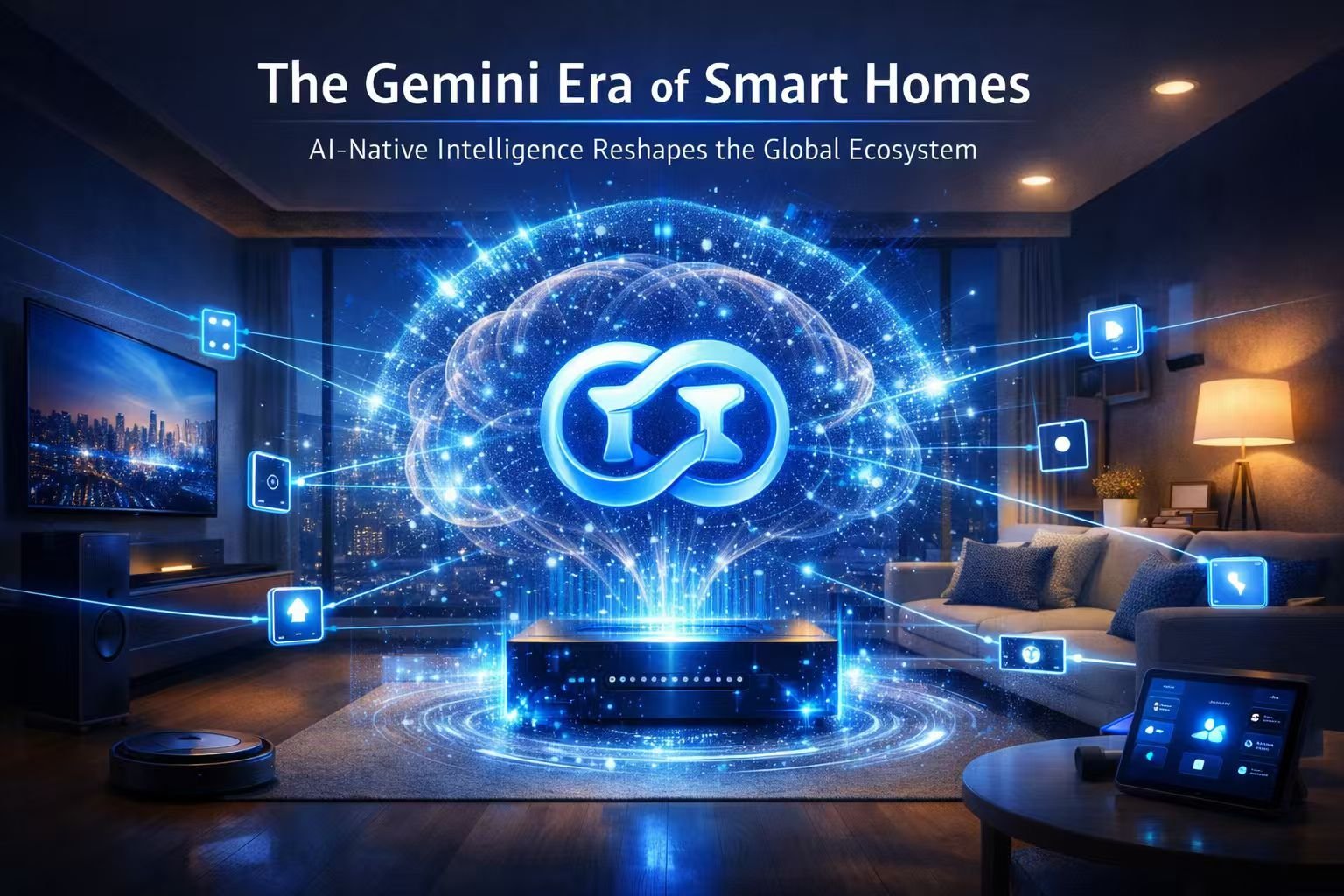
OpenAudio Full-Series Amplifiers Lead with Native Google Home & Gemini Integration
Introduction
March 31, 2026, marks a significant milestone in the evolution of voice ecosystems: Google officially transitions from Google Assistant to Gemini as the foundational AI layer across its smart home infrastructure.
This change is not a routine update. It represents a structural shift — from command-driven voice control to reasoning-based AI orchestration — reshaping how intelligent homes operate, how devices collaborate, and how premium hardware integrates with cloud intelligence.
From Command Execution to Contextual Intelligence
For over a decade, voice assistants such as Google Assistant, Siri, and Alexa operated primarily on structured command-response models.
They excelled at:
- Triggering individual devices
- Executing predefined routines
- Responding to direct instructions
However, their architectural foundation limited:
- Multi-step reasoning
- Context retention
- Intent interpretation
- Cross-device adaptive coordination
Gemini introduces a large-model-based AI architecture capable of:
- Continuous contextual awareness
- Intent-level understanding
- Multi-device orchestration
- Adaptive automation across scenarios
The shift transforms smart homes from reactive systems into intelligent environments capable of interpreting and managing complex interactions.
The Competitive Landscape: AI Architecture as the New Differentiator
The smart home competition is no longer defined by device quantity or ecosystem boundaries — it is increasingly defined by AI capability.
Apple Home (Siri)
Apple continues to prioritize privacy-centric, locally optimized systems. Its AI evolution emphasizes controlled integration within a tightly curated ecosystem.
Amazon Alexa
Alexa maintains strong device compatibility and commercial ecosystem reach. However, its AI layer historically relied on skill-based extensibility rather than foundational large-model reasoning.
Google Home + Gemini
With Gemini integrated natively, Google Home combines:
- Broad ecosystem openness
- Cross-platform compatibility
- Advanced large-model reasoning
- Multi-modal interaction
This elevates Google’s platform toward a more adaptive, context-aware smart home architecture.
The implications extend beyond voice — influencing hardware design, system integration strategy, and long-term ecosystem evolution.
Why OpenAudio Is Strategically Positioned
As AI-native smart homes emerge, hardware must evolve accordingly.
OpenAudio’s full-series amplifiers integrate natively with Google Home and Gemini, enabling:
- Natural-language volume and source control
- Context-aware scene triggering
- Multi-room orchestration
- Complex scenario automation
Voice interaction shifts from:
“Turn on the amplifier.”
to:
“Prepare the living room for movie night.”
Lighting, sound mode, and environment coordination can be managed through AI-driven intent interpretation.
This integration positions OpenAudio not merely as an amplifier manufacturer, but as an intelligent media node within AI-managed home ecosystems.
The Strategic Significance for Premium Audio
High-end audio can no longer rely solely on acoustic superiority.
In an AI-native era, premium positioning requires:
- Intelligent orchestration
- Seamless ecosystem compatibility
- Software-defined upgradability
- Future-proof integration
OpenAudio’s early adoption of Gemini-native integration reflects a forward-looking design philosophy: immersive sound must operate within intelligent systems, not alongside them.
Market Implications & Long-Term Outlook
The Gemini transition signals a broader shift toward AI-centric smart home infrastructure.
As foundational large models become embedded in ecosystem platforms:
- Hardware brands must design for AI-native environments
- Integrators must consider intelligence layers as core infrastructure
- Consumers will increasingly expect contextual automation rather than command control
OpenAudio’s full support for Gemini and Google Home represents a commitment to this next phase of intelligent home evolution.
Conclusion
The retirement of Google Assistant marks the end of a generation of voice control.
Gemini represents the beginning of AI-managed home environments.
In this transition from reactive devices to intelligent ecosystems, OpenAudio stands aligned with the structural direction of the industry — where immersive audio, network-native architecture, and AI intelligence converge.
The future of smart home audio is not merely louder.
It is smarter.