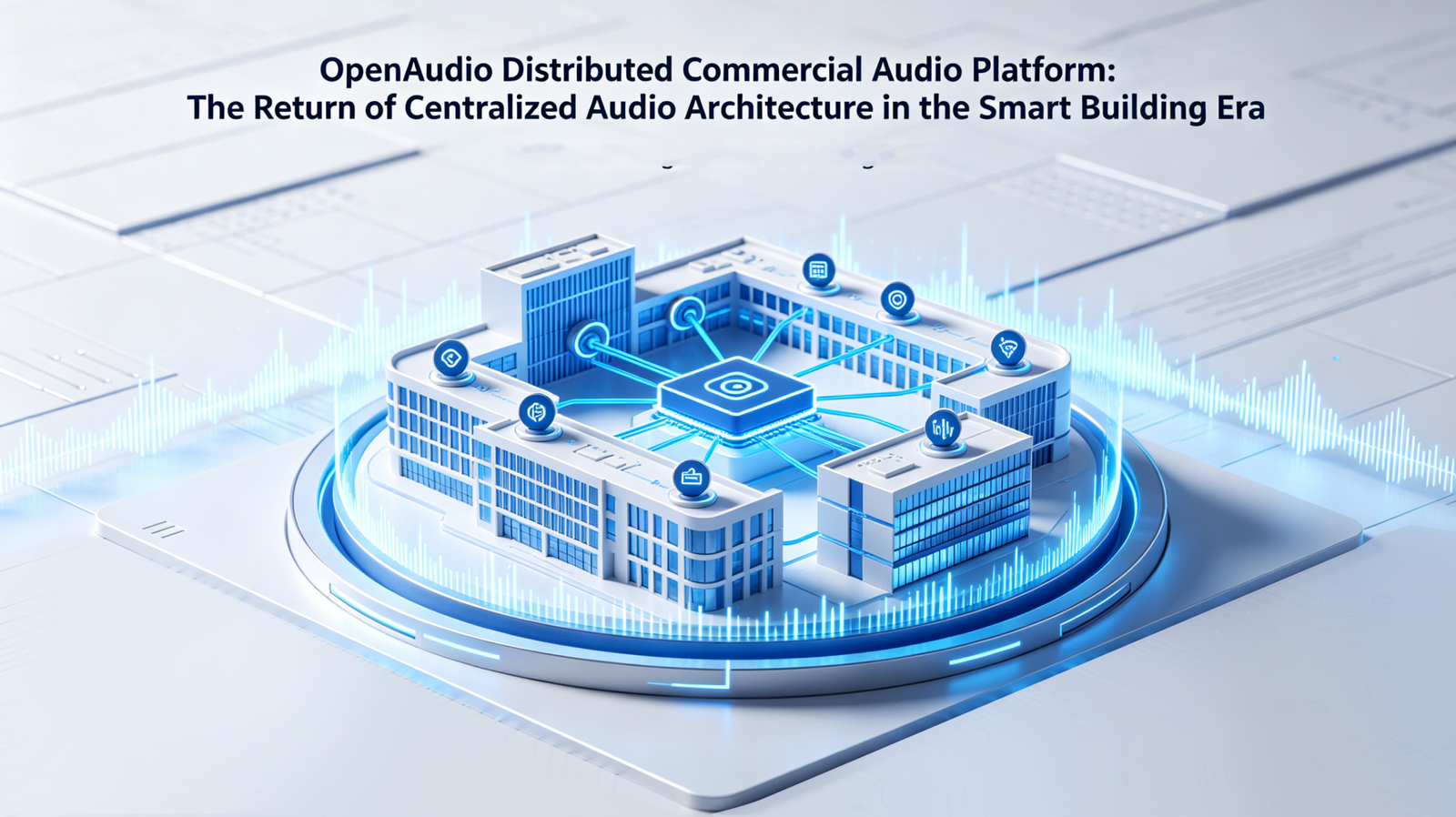
OpenAudio Distributed Commercial Audio Platform
The Return of Centralized Audio Architecture in the Smart Building Era
For many years, commercial audio systems followed a fragmented architecture model.
A typical hospitality or commercial deployment often required:
- Multiple independent streaming players
- Separate amplifiers for each zone
- External DSP or matrix systems
- Dedicated control processors
- Complex cabling and distributed maintenance
While this architecture worked, it introduced significant operational challenges:
- High deployment complexity
- Difficult troubleshooting
- Poor scalability
- Fragmented user experience
- Limited integration with smart building ecosystems
Today, the commercial AV industry is entering a new phase.
Centralized audio architecture is returning — not as a legacy approach, but as a modern infrastructure model designed for cloud services, automation ecosystems, and intelligent commercial spaces.
From Standalone AV Systems to Audio Infrastructure
Modern hospitality, retail and smart building projects no longer view audio as an isolated AV subsystem.
Instead, audio is becoming part of a broader intelligent building framework alongside:
- Lighting control
- HVAC
- Occupancy systems
- Smart scheduling
- Digital signage
- Building automation
- SaaS cloud services
In this new environment, traditional distributed audio approaches begin to show limitations.
Commercial projects increasingly demand:
- Unified centralized management
- Multi-zone cloud streaming
- Simplified maintenance
- Scalable deployment models
- API-driven control
- Smart building interoperability
This shift is driving the resurgence of centralized rack-mounted commercial audio platforms.
Why Centralized Architecture Is Returning
Several industry trends are accelerating this transition.
1. Multi-Stream SaaS Music Platforms
Commercial music services are rapidly evolving.
Platforms such as:
are transforming how background music is deployed and managed.
Instead of isolated music players in each room or zone, centralized streaming architectures now allow:
- Multiple simultaneous streams
- Unified cloud management
- Subscription-based audio deployment
- Remote monitoring and control
- Simplified content management
This dramatically reduces system complexity while improving operational flexibility.
2. Smart Building Ecosystem Convergence
Modern buildings increasingly rely on interconnected systems.
Commercial audio is no longer independent from:
- KNX
- Control4
- RTI
- Home Assistant
- Open Web APIs
- Building automation frameworks
The future belongs to systems capable of seamless interoperability.
Audio must now participate in:
- Scene control
- Scheduling
- Occupancy-driven automation
- Unified user experiences
This requires an infrastructure-oriented audio platform rather than isolated AV hardware.
3. Simplified Deployment & Maintenance
Traditional commercial AV deployments often involve:
- Numerous hardware endpoints
- Distributed power amplifiers
- Multiple independent streaming devices
- Complex signal routing
A centralized architecture consolidates:
- Streaming
- DSP
- Matrix routing
- Amplification
- Control integration
into a unified rack-based platform.
The result:
- Reduced installation cost
- Easier troubleshooting
- Simplified future expansion
- Improved reliability
- Lower maintenance overhead
OpenAudio Distributed Commercial Audio Platform
The OpenAudio Distributed Commercial Audio Platform was developed around this new infrastructure philosophy.
Rather than treating audio as a collection of isolated components, the platform is designed as a scalable centralized audio ecosystem for both residential and commercial projects.
Core platform capabilities include:
- 8-zone distributed audio architecture
- Up to 8 simultaneous AirPlay 2 streams
- Up to 8 simultaneous Google Cast streams
- DSP-powered matrix routing
- Centralized rack-mounted deployment
- Open Web API integration
- Native smart building compatibility
The platform is designed to integrate naturally with:
Flexible Commercial Deployment Architectures
Modern commercial projects require flexibility.
Different applications demand different deployment strategies.
The OpenAudio platform supports multiple architectural approaches:
Solution A — Direct Low-Impedance Architecture
Designed for:
- Restaurants
- Cafés
- Retail stores
- Boutique hospitality
- Luxury residential
Advantages:
- Simplified topology
- Reduced hardware footprint
- Lower deployment cost
- Easier maintenance
The platform supports native streaming integration with cloud-based commercial music services, enabling centralized multi-zone BGM without external streaming hardware.
Solution B — Extended Multi-Input Architecture
For larger commercial environments requiring multiple independent sources:
- Hotels
- Office towers
- Educational facilities
- Mixed-use developments
Expanded analog input architecture enables:
- Central DSP routing
- Flexible source switching
- Multi-source matrix control
- Unified rack-based management
Solution C — 70V / 100V Constant-Voltage Architecture
Commercial large-area projects often require:
- Long-distance speaker deployment
- Simplified large-scale wiring
- Scalable speaker expansion
Using L2H transformer solutions or the PP-series multi-mode amplifiers, the platform supports:
- Low-impedance
- 70V
- 100V
architectures simultaneously.
This enables flexible deployment across:
- Hotels
- Shopping malls
- Public venues
- Schools
- Transportation hubs
Solution D — Dynamic Power Pool Architecture
The PP6002 and PP6004 platforms introduce dynamic power allocation concepts inspired by modern commercial installation requirements.
Advantages include:
- Flexible per-channel loading
- Optimized amplifier utilization
- Reduced hardware waste
- Simplified deployment
- Support for mixed low-Z and constant-voltage applications
This architecture is especially valuable for asymmetrical commercial environments where different zones require different power levels and speaker topologies.
SaaS + Audio + Automation
One of the most important industry transformations is the convergence of:
- SaaS music services
- Smart building automation
- Distributed audio infrastructure
The future commercial audio platform is no longer simply:
“an amplifier.”
It becomes:
- A streaming infrastructure platform
- A building subsystem
- A cloud-managed service layer
- A smart building participant
This convergence creates new possibilities:
- Centralized BGM management
- Unified scene automation
- Cloud-driven audio scheduling
- Commercial subscription integration
- Cross-system interoperability
The Future of Commercial Audio
The commercial AV industry is shifting away from fragmented standalone devices toward infrastructure-oriented platforms.
Future systems will prioritize:
- Centralized management
- Cloud integration
- Multi-stream architectures
- Smart building interoperability
- SaaS ecosystems
- Simplified deployment models
In this transition, distributed audio evolves from an isolated AV product category into a core layer of intelligent building infrastructure.
The future of commercial audio is no longer just about playback.
It is about platform architecture.
For more information, please visit the official website of OpenAudio: www.openaudio.io