From Control to Interaction: The Three Evolutions of the OpenAudio Web API
Multi-room audio integration used to be relatively simple.
A third-party control system needed to select a source, adjust the volume, mute a room, or route audio from one source to another zone. For many installations, that was enough.
But the way people interact with music has changed.
Modern audio is increasingly driven by streaming services, rich metadata, touch interfaces and automation platforms. Users no longer expect a control system simply to turn audio on and adjust the volume. They expect to see what is playing, understand its current status, and interact with playback directly.
The evolution of the OpenAudio Web API reflects this change.
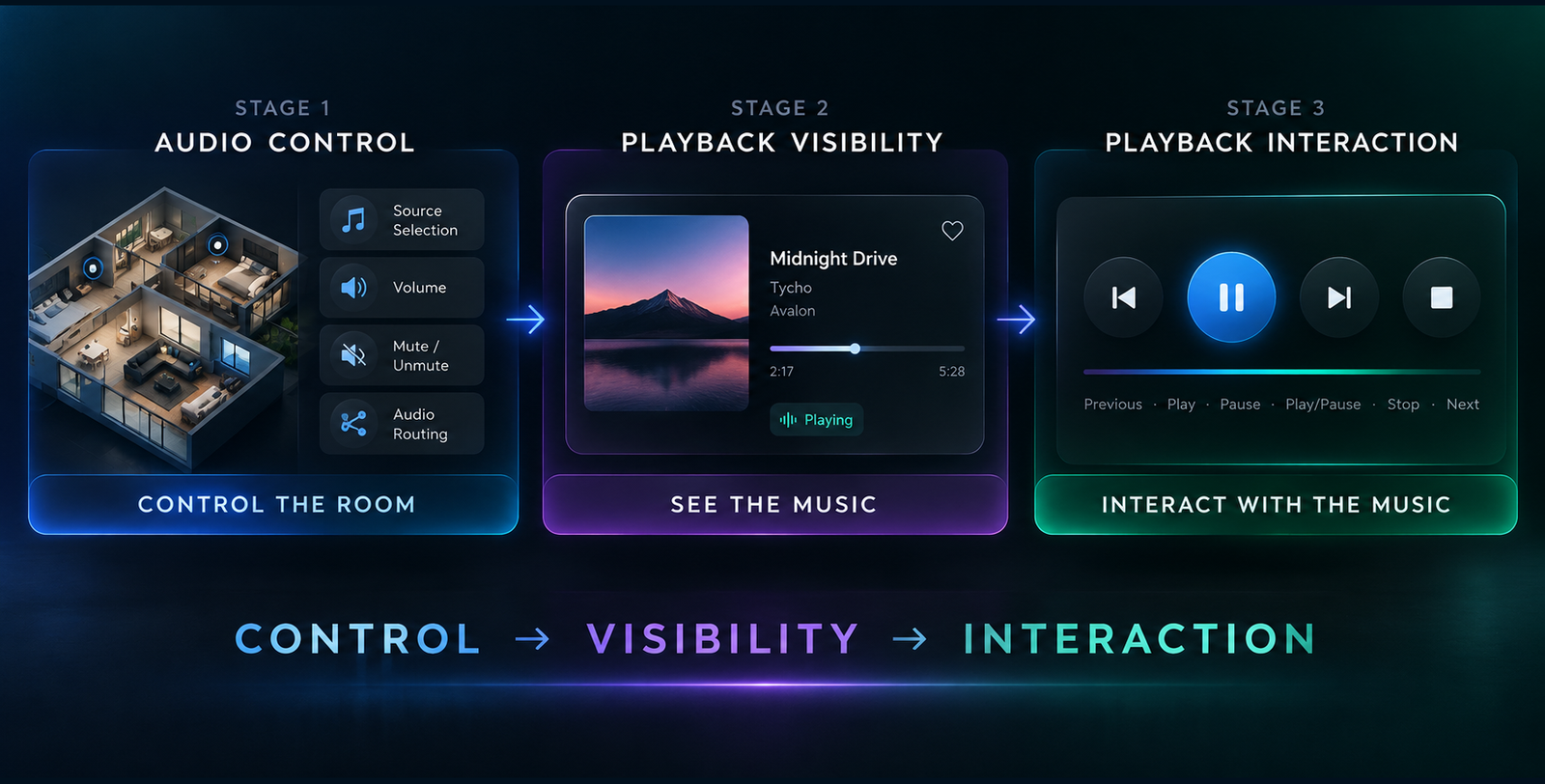
Over time, the API has gone through three major stages:
Audio Control → Playback Visibility → Playback Interaction
Each stage represents more than the addition of new commands. Together, they reflect the evolution of OpenAudio from a controllable multi-room audio system into a deeper integration platform for the modern smart home and connected building.
The First Evolution: Controlling the Audio System
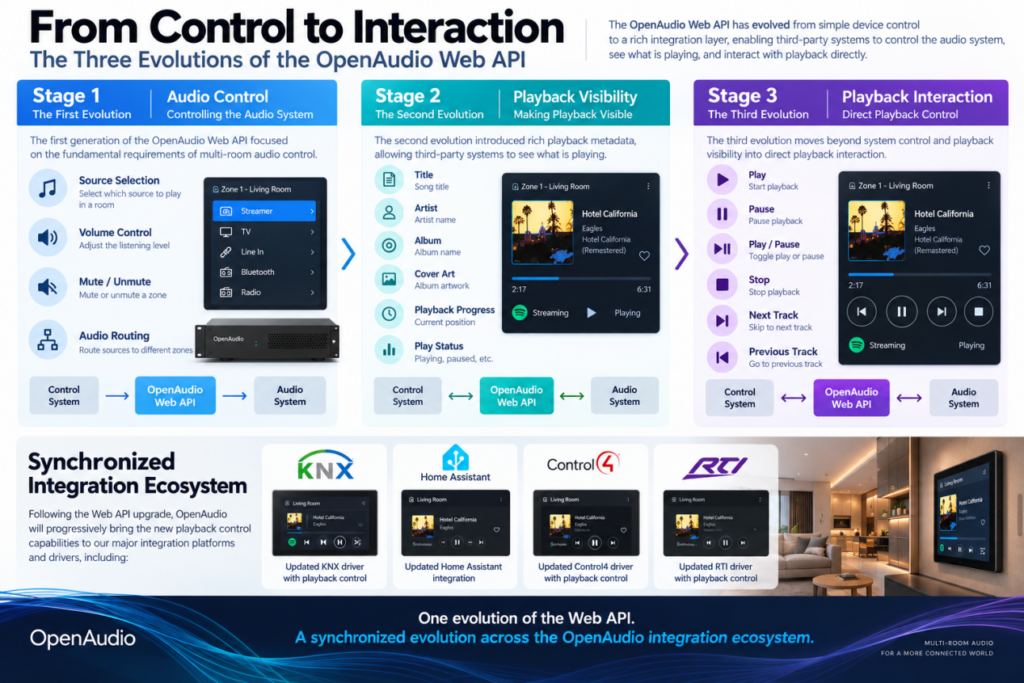
The first generation of the OpenAudio Web API focused on the fundamental requirements of multi-room audio control.
Third-party systems could perform essential functions including:
Source Selection
Mute / Unmute
Volume Control
Audio Routing
This established the basic control layer between OpenAudio and external automation platforms.
A third-party interface could select which source should play in a particular room, adjust the listening level, mute or unmute a zone, and route different audio sources independently across multiple zones.
Conceptually, the architecture was straightforward:
Control System → OpenAudio Web API → Audio System
For smart-home and automation integration, this was an important first step.
It allowed OpenAudio to become part of a larger control environment rather than operating only through its own application.
But this first generation essentially answered one question:
What do you want the audio system to do?
As streaming became increasingly central to the listening experience, another question became just as important:
What is the audio system actually playing?
That led to the second evolution.
The Second Evolution: Making Playback Visible
Streaming changed the role of the user interface.
A modern touch panel or automation interface should not simply display a room name, a source number or the word “Playing.”
It should be able to show the music itself.
The second evolution of the OpenAudio Web API therefore introduced rich playback metadata, including:
Title
Artist
Album
Cover Art
Playback Progress
Play Status
This fundamentally changed what a third-party interface could become.
Instead of acting as a collection of volume buttons and source selectors, an automation interface could begin to behave like a real music interface.
A wall-mounted touch panel, for example, could display:
Now Playing
Song Title
Artist
Album
together with album artwork, current playback progress and playback status.
The architecture therefore evolved from simple one-way control:
Control System → Commands → OpenAudio
toward a richer two-way relationship:
Control System ⇄ OpenAudio
The external platform could now both control the audio system and understand what was happening inside it.
This was an important step for integrations involving smart-home platforms, visualization systems, touch panels and customized user interfaces.
The difference was significant.
Stage 1 allowed the control system to control the room.
Stage 2 allowed the control system to see the music.
But one important capability was still missing.
The user could see what was playing, but a third-party interface still needed deeper control over the playback itself.
That brings us to the third evolution.
The Third Evolution: Direct Playback Control
The third evolution takes the OpenAudio Web API beyond system control and playback visibility into direct playback interaction.
The Web API now extends playback control with:
Play
Pause
Play / Pause
Stop
Previous Track
Next Track
At first glance, these may appear to be simply several additional API commands.
But from an integration perspective, they represent something more important.
They complete another layer of the interaction between OpenAudio and third-party systems.
Consider the evolution of a smart-home touch panel.
With the first generation of the API, it could control:
Room → Source → Volume → Mute → Routing
With the second generation, it could additionally display:
Title → Artist → Album → Cover Art → Progress → Play Status
And with the third generation, the same interface can now provide direct playback interaction:
Play → Pause → Play/Pause → Stop → Previous → Next
The result is a much more complete audio interaction model.
Users no longer need to move constantly between a smart-home interface and a separate audio interface simply to perform basic playback operations.
The automation interface itself can become a meaningful part of the music experience.
Three Evolutions, Three Layers
The evolution of the OpenAudio Web API can therefore be summarized in three layers.
Stage 1 — Audio Control
Source Selection · Volume · Mute / Unmute · Routing
The external system can:
Control the room.
Stage 2 — Playback Visibility
Title · Artist · Album · Cover Art · Progress · Play Status
The external system can:
See the music.
Stage 3 — Playback Interaction
Play · Pause · Play/Pause · Stop · Previous · Next
The external system can:
Interact with the music.
These three stages represent a clear progression:
Control the room → See the music → Interact with the music
And together, they transform the OpenAudio Web API from a basic device-control interface into a much richer integration layer.
Why This Matters for System Integrators
For system integrators, the significance goes far beyond adding several new API commands.
It changes what can be built on top of the OpenAudio platform.
A smart-home touch panel, KNX visualization, customized mobile application, hotel control interface or third-party automation system can increasingly provide a unified audio experience without treating the audio system as an isolated black box.
The control system can know:
Which source is selected.
Which room is playing.
What song is playing.
Who the artist is.
Which album it belongs to.
What the cover artwork looks like.
How far playback has progressed.
Whether playback is active or paused.
And now, it can also interact directly with that playback.
This becomes particularly important as audio moves deeper into the smart-home, hospitality and building-automation environment.
Users increasingly expect lighting, climate, shading, security, entertainment and audio to coexist within one coherent digital experience.
For audio to participate properly in that environment, integration needs to go far beyond basic volume commands.
Extending the Evolution Across the OpenAudio Integration Ecosystem
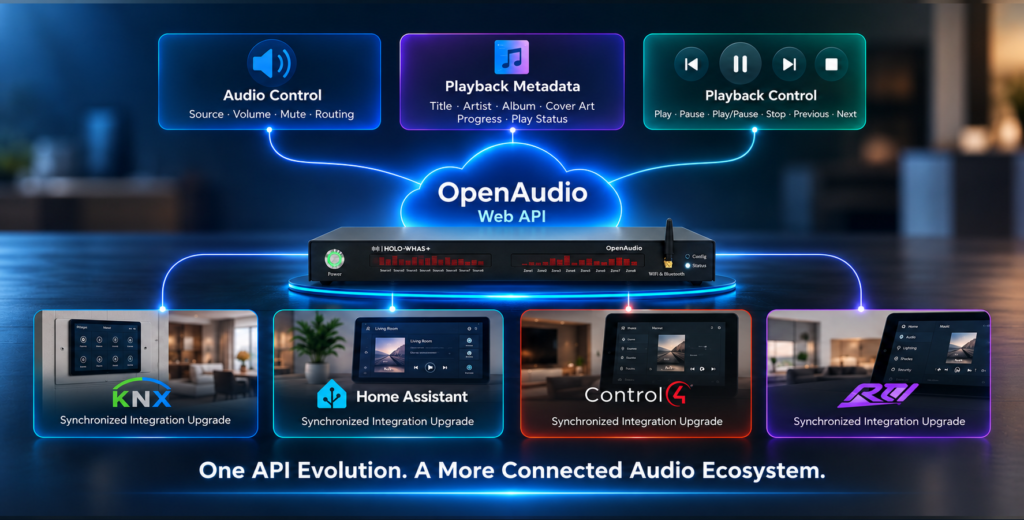
The third evolution does not stop with the Web API.
The Web API provides an important foundation for OpenAudio‘s wider integration architecture.
Following this upgrade, we will progressively synchronize the new playback-control capabilities across our major third-party integration platforms and drivers, including:
This means the same evolution taking place in the Web API can progressively extend across the wider OpenAudio integration ecosystem.
A KNX touch panel should not simply control volume.
A Home Assistant dashboard should not simply turn a zone on or off.
A Control4 interface should not simply select an input.
An RTI interface should not simply send basic audio commands.
As these integrations evolve, the goal is to enable third-party platforms to provide a richer and increasingly consistent interaction with the OpenAudio system.
In other words:
Web API → KNX / Home Assistant / Control4 / RTI
The evolution of the API becomes the foundation for the evolution of the wider integration ecosystem.
From an Audio Product to an Audio Platform
This evolution also reflects a broader direction for OpenAudio.
We do not see multi-room audio simply as an amplifier connected to an app.
We see audio as part of a larger connected environment.
The amplifier provides the physical audio infrastructure.
Streaming provides the content.
The Web API provides an integration layer that allows other systems to understand, control and interact with that infrastructure.
And our integration platforms extend those capabilities into the wider automation ecosystem.
That is why the evolution of the OpenAudio Web API can be understood in three simple steps:
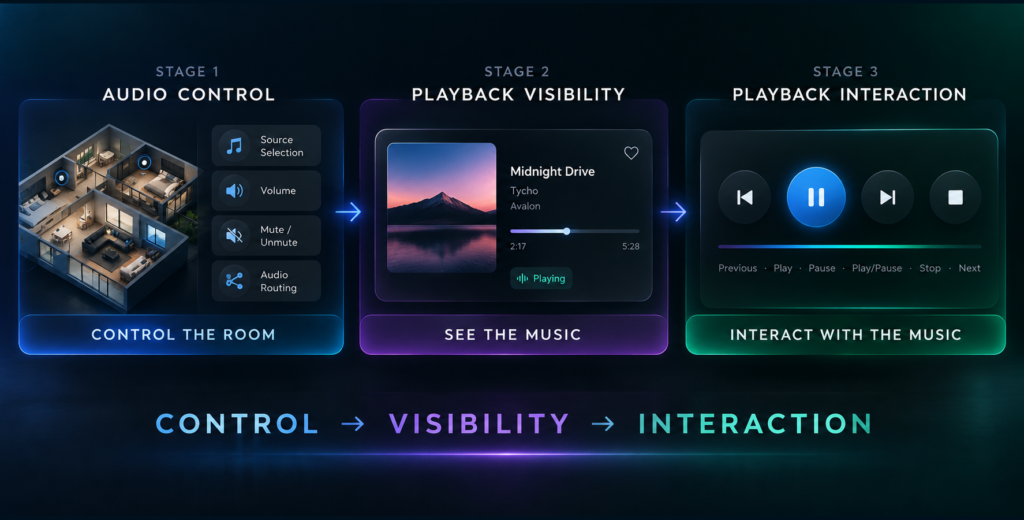
Stage 1 gave third-party systems control.
Stage 2 gave them visibility.
Stage 3 gives them interaction.
Or even more simply:
Control the room.
See the music.
Interact with the music.
The next generation of integrated audio will not be defined only by how many channels an amplifier has or how much power it can deliver.
It will also be defined by how naturally audio can participate in the wider smart-home, building automation and hospitality ecosystem.
One evolution of the Web API.
A synchronized evolution across the OpenAudio integration ecosystem.
That is the direction in which OpenAudio continues to evolve.