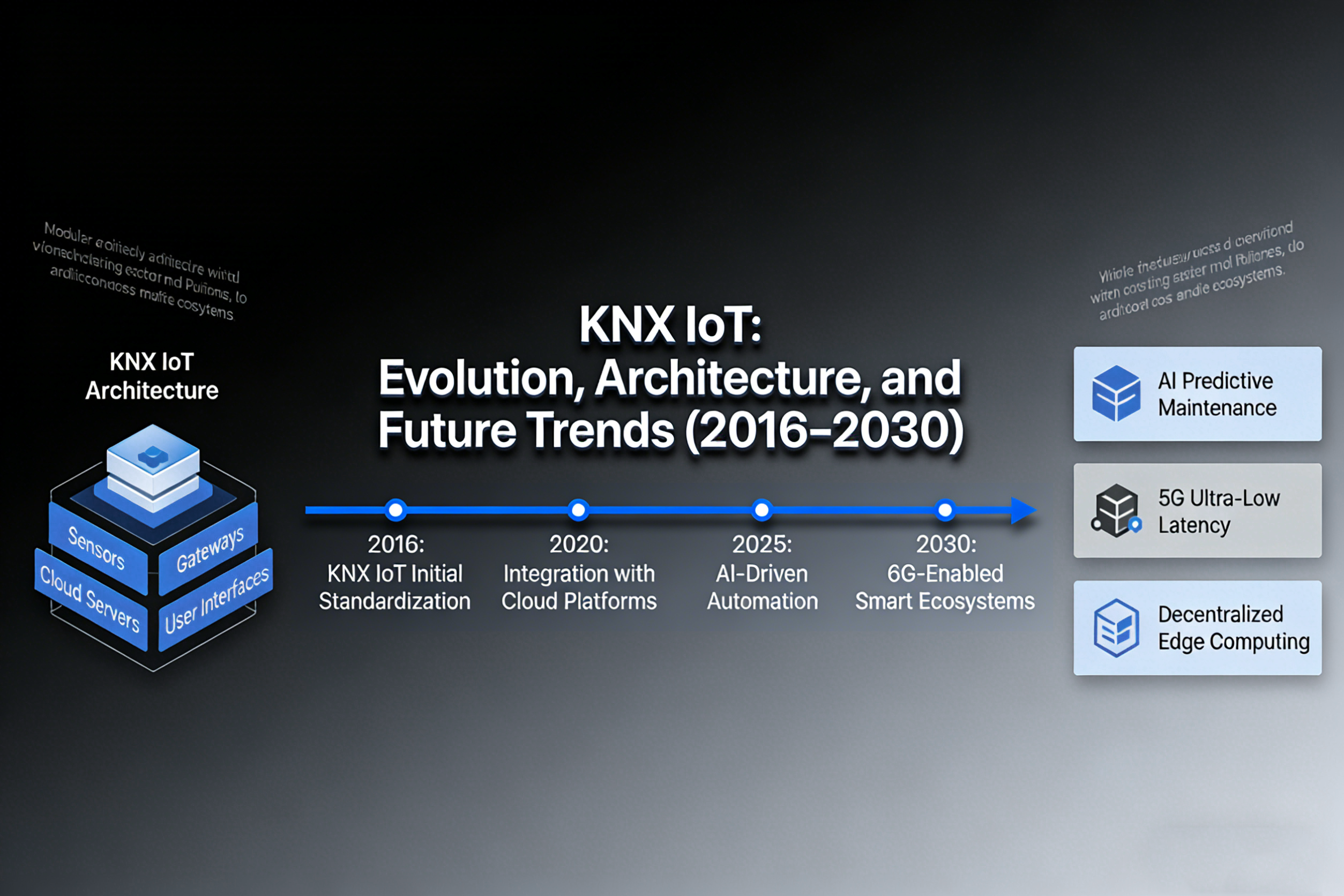
KNX IoT: Evolution, Architecture, and Future Trends (2016–2030)
Introduction: Why KNX Is Moving Toward IoT
For over three decades, KNX Association has led the global standard for building automation. Traditional KNX systems—based on TP (twisted pair) and KNX/IP—have proven to be highly reliable and scalable.
However, the rise of IoT and cloud-based ecosystems has exposed several limitations:
- Limited compatibility with modern web technologies (REST, APIs, cloud platforms)
- Complex integration with mobile apps and third-party services
- Lack of alignment with emerging ecosystems like Matter
As a result, KNX IoT was introduced to transform KNX from a fieldbus system into a native IP-based architecture.
Phase 1: Concept Exploration (2016–2019)
During this phase, KNX began exploring how to integrate with the broader IoT ecosystem.
Key Technical Directions
IPv6 Adoption
The concept of assigning each device a unique IP address emerged:
Each device = an IP node
This marked a shift away from traditional KNX addressing toward network-native communication.
CoAP Integration
The Constrained Application Protocol (CoAP) was introduced as a lightweight alternative to HTTP:
- Designed for embedded systems
- Supports Observe (subscription model)
- Optimized for low-power networks like Thread
CoAP later became the foundation of KNX IoT communication.
Data Model Transformation
Traditional KNX:
Group Address → Data
IoT-oriented model:
Resource (/p/inverter) → Data
This transition from address-based to resource-based communication was fundamental.
Industry Context
At the same time:
- Voice assistants (Alexa, Google Home) gained traction
- Smart home platforms became cloud-centric
- APIs became the standard for integration
KNX needed to adapt or risk losing relevance.
Summary of Phase 1
A strategic shift from industrial protocol to internet-native architecture
Phase 2: Standardization and Release (2020)
This marks the official birth of KNX IoT.
Core Components Introduced
KNX IoT Point API (Device Layer)
- Based on CoAP + IPv6
- Each function is exposed as a resource
- Supports GET / PUT / OBSERVE
Example:
/p/inverter → float (power value)
KNX IoT 3rd Party API (Application Layer)
- Based on REST / HTTP
- Uses OAuth2 authentication
- Designed for:
- Cloud platforms
- Building Management Systems (BMS)
- Mobile applications
Architectural Shift
KNX becomes a two-layer system:
Device Layer (CoAP)
Application Layer (REST API)
This was a major evolution from KNX’s traditional architecture.
Industry Impact
Despite the technological leap:
- Very few commercial products existed
- Toolchains were immature
- Integrators were unfamiliar with the new model
This phase was characterized by:
Standard maturity > Market adoption
Phase 3: Open Source and Ecosystem Development (2021–2023)
This is the phase where many developers—including your current work—are actively involved.
Key Developments
Open-Source Stack Availability
KNX released the KNX IoT Point API Stack:
- Enables rapid prototyping
- Provides reference implementations
- Reduces development barriers
Thread Network Integration
KNX IoT began supporting multiple transport layers:
Thread / Wi-Fi / Ethernet
Thread, in particular, is important for:
- Low-power mesh networking
- Native IPv6 support
Semiconductor Ecosystem
Major chip vendors joined:
- Silicon Labs
- NXP
- Nordic
Providing hardware and development kits.
Challenges in This Phase
This is where most developers struggle:
- Lack of mature debugging tools
- Incomplete documentation
- Complexity of CoAP + IPv6
This phase can be summarized as:
Technically viable, but not yet engineer-friendly
Phase 4: Convergence and Market Activation (2024–Present)
This phase marks the beginning of real industry relevance.
The Role of Matter
Matter is a major catalyst:
- Unified device model
- Cross-platform interoperability
- Entry into consumer ecosystems
KNX IoT’s New Position
KNX IoT = bridge between professional systems and IoT ecosystems
- Upstream: cloud, apps, Matter
- Downstream: KNX devices
Multi-System Integration
Modern systems now integrate:
- Control4
- Home Assistant
- Apple / Google / Alexa ecosystems
Multi-protocol environments are becoming the norm.
Emerging Opportunity: Multi-Room Audio
KNX IoT enables new possibilities:
- Each audio zone becomes an IoT endpoint
- Seamless integration with lighting, HVAC, and automation scenes
- Unified control via cloud and local systems
This is a key opportunity for modern audio solutions like multi-zone streaming amplifiers.
Future Trends (2025–2030)
- Deep Integration with Matter
- Matter as the consumer interface
- KNX IoT as the professional backbone
- Cloud-Native Building Automation
Buildings will become API-driven systems
- Remote management
- Data analytics
- Scalable deployments
3> AI-Driven Automation
- Predictive control
- Energy optimization
- Context-aware automation
4>Unified Smart Systems
Future systems will merge:
- Lighting
- HVAC
- Security
- Audio
Into a single integrated platform.
Conclusion
KNX IoT is not replacing KNX — it is redefining how KNX connects to the future.
- Age: ~5 years
- Stage: Early growth
- Potential: Extremely high
For manufacturers and integrators:
Investing in KNX IoT today means securing a position in tomorrow’s ecosystem.