


OpenAudio Routing Groups: Going Beyond AirPlay Multi-Selection and Google Cast Grouping
Introduction: When Protocol UX Is No Longer Enough
AirPlay and Google Cast have defined how users interact with multi-room audio for years.
AirPlay offers on-the-fly multi-selection, while Google Cast relies on predefined device groups. Both approaches work well within their respective ecosystems—but they also reveal clear limitations once audio systems grow beyond a few speakers.
With OpenAudio Routing Groups, multi-room audio moves beyond protocol-level UX and into a system-level routing model, where zones, sources, and group logic are managed centrally inside the HoloHome App, independent of whether the input comes from AirPlay, Google Cast, or other streaming sources.
What Are Routing Groups in the HoloHome App?
Routing Groups are logical audio groupings defined at the system layer, not at the protocol layer.
In the HoloHome App, users can:
- Select any combination of audio zones
- Route a single audio source to multiple zones
- Save these combinations as named groups, such as:
- All Rooms
- Living + Kitchen
- Party
- Outdoor
- Recall or modify these groups instantly at any time
Once created, these groups live inside the OpenAudio system, not inside AirPlay or Google Cast.
How Routing Groups Work in Practice
A typical flow looks like this:
- A user starts playback via AirPlay, Google Cast, or another supported source
- Audio enters the OpenAudio system as a single stream
- Inside the HoloHome App, the user chooses:
- Which zones receive the audio
- Whether to use an existing Routing Group (e.g. Party)
- The system handles:
- Zone routing
- Synchronization
- Group persistence
The streaming protocol provides the content, while OpenAudio controls the distribution.
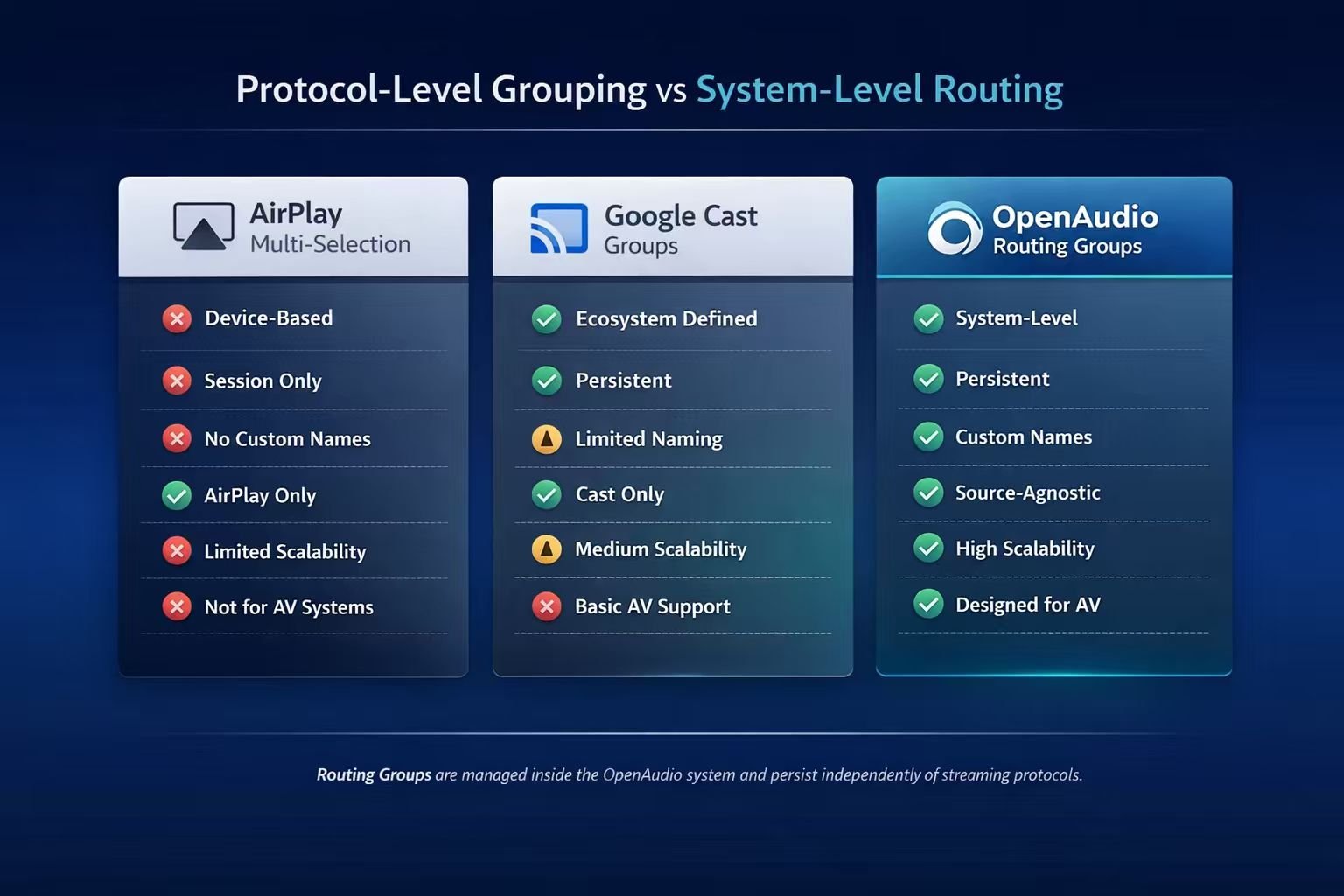
Routing Groups vs. AirPlay Multi-Selection vs. Google Cast Group
The key difference is where grouping logic lives.
Core Conceptual Difference
- AirPlay Multi-Selection
→ Grouping is created by the phone, per session - Google Cast Group
→ Grouping is created by the Cast ecosystem, pre-configured - OpenAudio Routing Groups
→ Grouping is created by the audio system itself, persistent and reusable
Feature Comparison Table
| Feature | AirPlay Multi-Selection | Google Cast Group | OpenAudio Routing Groups |
| Where groups are defined | iOS device | Google Cast ecosystem | HoloHome App (system layer) |
| Group persistence | ❌ Session-only | ✅ Persistent | ✅ Persistent |
| Custom group names | ❌ | Limited | ✅ Fully customizable |
| Dynamic regrouping | ✅ | ❌ | ✅ |
| Protocol dependent | Yes (AirPlay only) | Yes (Cast only) | ❌ Protocol-agnostic |
| Works across sources | ❌ | ❌ | ✅ |
| Multi-zone scalability | Limited | Medium | High |
| Designed for AV systems | ❌ | ❌ | ✅ |
Why Routing Groups Go Beyond Native Protocol Behavior
Protocols Are Entry Points, Not System Controllers
AirPlay and Google Cast were designed for consumer playback, not for managing complex multi-zone audio systems.
Routing Groups treat these protocols as inputs, not decision-makers.
Group Logic Becomes Independent of the Source
With Routing Groups:
- The same Party group can be used for:
- AirPlay
- Google Cast
- Network streaming
- Local inputs
Users don’t need to rebuild groups every time they switch apps or platforms.
A Single UX for All Ecosystems
Instead of learning:
- AirPlay rules on iOS
- Cast rules on Android
Users interact with one consistent interface: the HoloHome App.
This is especially important in households and projects where iOS, Android, and automation systems coexist.
Designed for Real Multi-Zone Audio Systems
Routing Groups are not a workaround—they are a core architectural feature of OpenAudio’s multi-zone platforms.
They are designed for:
- Permanent installations
- Whole-home audio
- Home cinema + distributed audio coexistence
- Integration with smart home systems
This makes Routing Groups fundamentally different from temporary, protocol-driven grouping mechanisms.
Conclusion: From Protocol UX to System Intelligence
AirPlay Multi-Selection and Google Cast Grouping are effective within their own boundaries.
But as audio systems scale, system-level control becomes essential.
With Routing Groups in the HoloHome App, OpenAudio moves grouping logic out of individual ecosystems and into the audio platform itself—enabling persistent, flexible, and source-agnostic multi-room audio experiences.
This is not about replacing AirPlay or Google Cast.
It is about going beyond them.



ryan
27 Jan, 2026This routing logic is a total game changer. Being able to bridge different protocols in one group is exactly what the "smart home" has been missing for years.
Thomas
26 Jan, 2026I much prefer using OpenAudio Routing Groups over Airplay multi-selection or Google Home Groups. Having native hardware-level control ensures far better synchronization and audio integrity.