Introduction
As physical media fades from the mainstream and HDMI transitions from core backbone to optional interface, home theater is entering a new architectural cycle — one defined by network-native delivery, immersive decoding and whole-home intelligence.
OpenAudio redefines the AVR not merely as an amplifier, but as the intelligent digital brain of modern home entertainment — orchestrating content, transmission, acoustics and ecosystem integration within a unified network-first architecture.
I. Industrial Transformation: The AVR Becomes the System Core
Fully Digital Content Sources
Disc-based playback is no longer the center of the experience.
Content now originates from:
- Streaming platforms
- NAS libraries
- Cloud services
- Game consoles
Users expect:
- Lossless immersive audio
- Low latency
- Seamless multi-room synchronization
- Flexible device switching
The content layer has become fully digital.
Transmission Backbone Evolves Toward IP
HDMI remains present — but increasingly as the “last meter” rather than the backbone.
Modern infrastructure is driven by:
- Wi-Fi 6E
- Gigabit Ethernet
- IP-based audio/video delivery
Immersive formats are no longer confined to pass-through architecture.
AVR as Media Brain
The next-generation AVR manages:
- Immersive decoding
- Soundfield reconstruction
- Source orchestration
- Multi-zone distribution
- Smart home integration
The amplifier is no longer peripheral — it is the gateway of the entire entertainment ecosystem.
II. Immersive Audio Redefined by Global Tech Leaders
Apple: Spatial Audio Ecosystem
Apple’s spatial audio ecosystem integrates dynamic head tracking and personalized rendering across Apple TV, iPhone and Mac, shaping a tightly integrated streaming-first immersive environment.
Google × Samsung: Eclipsa Audio (IAMF)
Based on the Alliance for Open Media’s IAMF model, Eclipsa Audio introduces object-based 3D rendering and adaptive multi-device playback across Android TV, YouTube and Samsung displays — designed natively for network media delivery.
Emerging Landscape
Immersive audio is evolving toward:
- Multi-format coexistence
- Cross-ecosystem compatibility
- Network-native decoding
- Software-driven scalability
The future requires AVRs capable of flexible, format-agnostic processing.
III. OpenAudio Core Technology: Designed for Network-Native Architecture
Full-Platform Streaming Support
OpenAudio integrates:
- Dual-band Wi-Fi 6E
- Gigabit Ethernet
- AirPlay 2
- Google Cast
- QPlay
- Spotify Connect
Ensuring stable 4K and immersive transmission across modern ecosystems.
Full-Format Immersive Decoding
Native decoding support includes:
- Dolby Atmos
- DTS:X
- IMAX Enhanced
With forward compatibility for emerging spatial audio standards such as ASAF and IAMF-based implementations.
Direct NAS playback enables high-bitrate, lossless audio over LAN without structural reliance on HDMI pass-through.
High-End Amplification Architecture
- Independent multi-channel amplification
- High-current delivery
- Low distortion topology
- Segmented power supply design
- Anti-resonance chassis engineering
Engineered for dynamic precision and acoustic control.
Intelligent Room Calibration
Multi-point acoustic measurement corrects:
- Standing waves
- Frequency response
- Imaging alignment
Transforming living spaces into optimized cinematic environments.
Whole-Home Multi-Zone Architecture
- Independent or synchronized playback
- Zone-level volume control
- Scene automation
- Smart home integration
OpenAudio extends beyond a single room into distributed audio intelligence.
III. OpenAudio Product Portfolio
Flagship Series
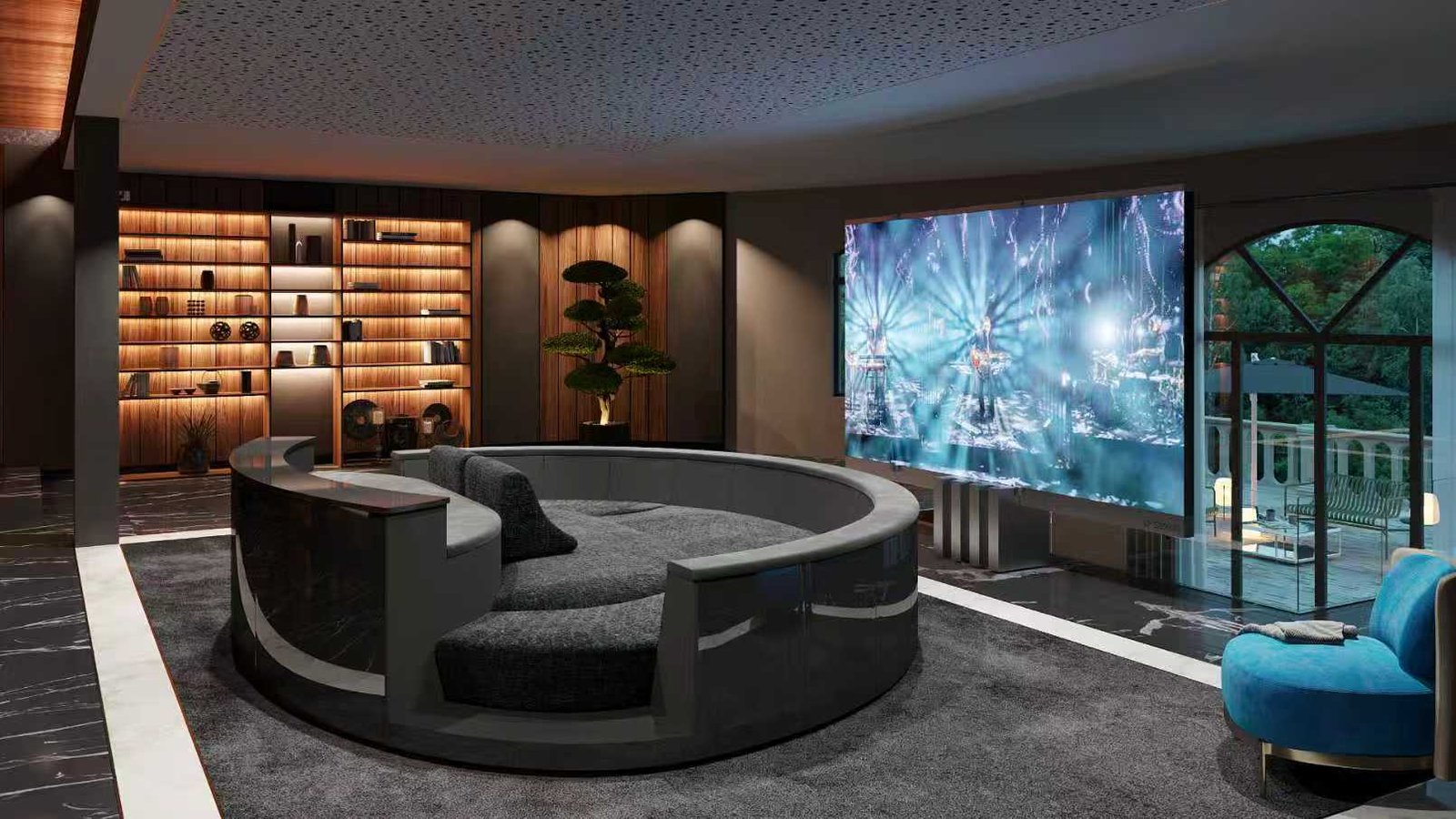
Designed for dedicated theaters, villas and custom installations:
- 9.2.4 / 11.2.6 configurations
- High-output amplification
- Professional-grade immersive environments
Mainstream Series
Optimized for modern living rooms:
- Compact architecture
- Efficient multi-channel design
- Simplified immersive upmixing
- Reduced wiring complexity
Smart Ecosystem Integration
- Voice control
- Remote management
- Low-latency gaming mode
- Cross-platform smart home compatibility
IV. Generational Advantages of OpenAudio
Network-Centered Architecture
Reduces dependence on complex wiring and future-proofs infrastructure.
Immersive Audio Beyond Pass-Through
Supports disc-free, streaming-first immersive playback.
Cross-Ecosystem Compatibility
Compatible with Apple, Google and Samsung spatial ecosystems — without ecosystem lock-in.
Software-Upgradable Platform
Firmware-based expansion supports evolving formats and long-term lifecycle value.
IV. Brand Positioning: OpenAudio and the Network Media Era
As physical media declines and immersive audio becomes network-native, OpenAudio aligns with the structural transformation of the industry.
Rather than replicating legacy architectures, OpenAudio is engineered for intelligent, distributed, software-defined home theater environments.
Explore the full lineup at:
www.openaudio.io
Conclusion
The home theater industry is not shrinking — it is evolving.
From discs to streaming.
From cables to networks.
From pass-through to intelligent orchestration.
OpenAudio stands at the center of this transition — built for networks, designed for immersion, powered by intelligence.
The next generation begins here.