


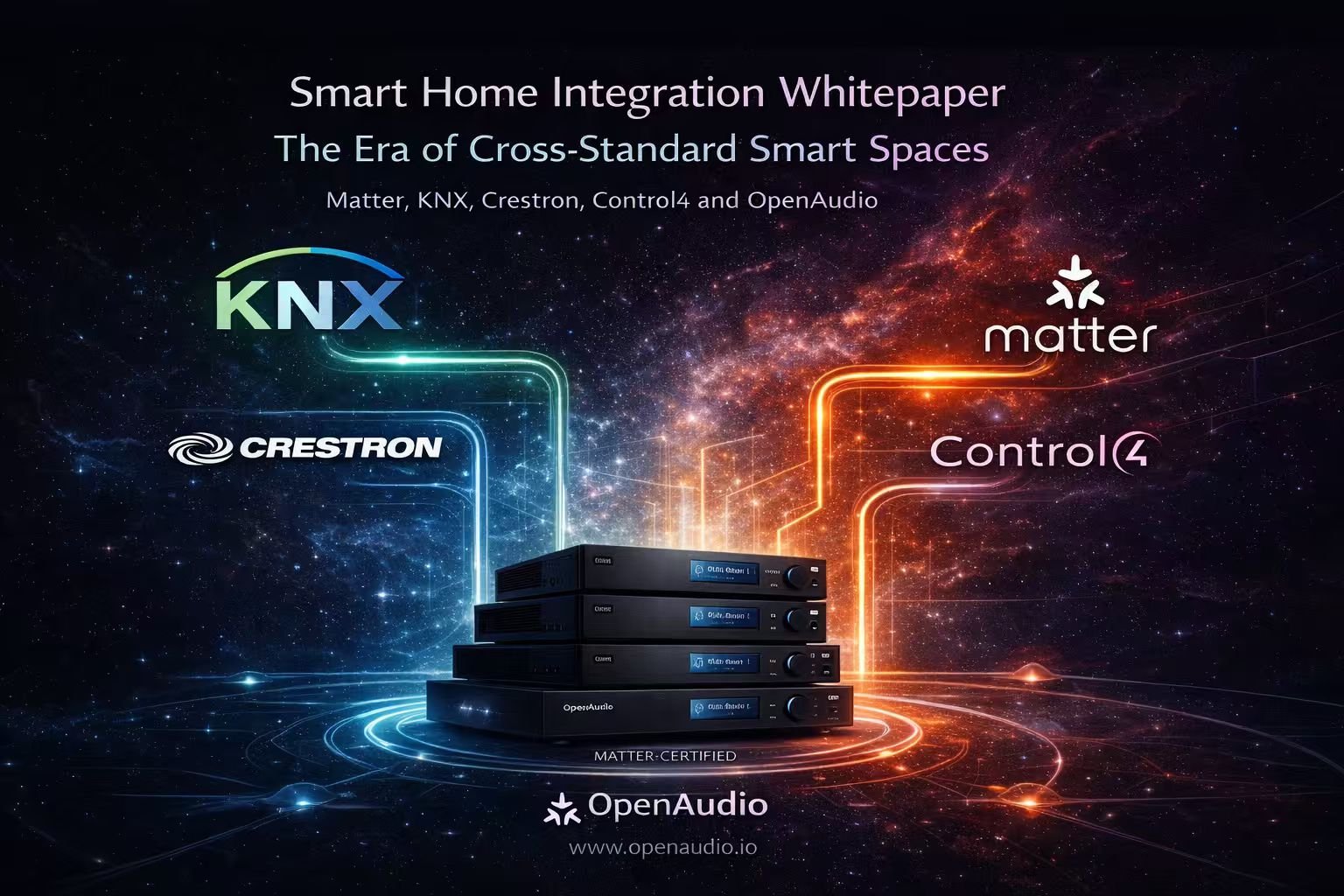
Convergence, Interoperability and the Future Architecture of Intelligent Spaces
Introduction
For over two decades, the smart home and intelligent building industry has been divided into two parallel worlds:
- Consumer-grade wireless ecosystems (Apple, Google, Amazon)
- Professional wired automation systems (KNX, Crestron, Control4)
With the rise of Matter, the industry now has a universal IP-based language designed to unify devices across brands.
But critical questions remain:
- Will Matter replace KNX, Crestron or Control4?
- Can they communicate natively?
- What will the future architecture of intelligent spaces look like?
This paper provides a definitive technical and strategic analysis — and explains how OpenAudio is positioned at the center of this convergence.
1. Clarifying the Core Truth: These Are Not the Same Type of System
Matter does not compete directly with KNX, Crestron, or Control4.
They solve fundamentally different problems.
Matter
An IP-Based Interoperability Standard
- Defined by the Connectivity Standards Alliance (CSA)
- Built on Wi-Fi, Thread, and Ethernet
- Software protocol only (no hardware form factor)
- Designed for plug-and-play consumer devices
- Unified control via Apple Home, Google Home, Alexa, SmartThings
Purpose:
Enable cross-brand interoperability for smart home devices.
KNX
A Global Building Automation Standard (ISO/IEC 14543)
- Established in 1999
- Primarily wired (KNX TP), also supports KNX IP
- Used in villas, hotels, office buildings, commercial infrastructure
- Engineering-grade reliability and lifecycle management
Purpose:
Mission-critical building automation and electrical system integration.
Crestron
High-End Centralized Control Platform
- Private protocol
- Controller-based architecture
- Used in luxury estates, boardrooms, five-star hotels
- Advanced programming and deep system logic
Purpose:
Total centralized system orchestration.
Control4
Residential Automation Platform
- Hybrid private/IP architecture
- Strong in home cinema + luxury residential integration
- Easier deployment than Crestron
- Installer-focused ecosystem
Purpose:
Integrated home automation and entertainment control.
Summary Table: Architectural Comparison
| Dimension | Matter | KNX | Crestron | Control4 |
| Category | Interoperability protocol | Building bus standard | Central control system | Automation platform |
| Architecture | Distributed IP | Wired bus + IP | Central controller | Hybrid |
| Market | Consumer | Engineering | Ultra high-end | High-end residential |
| Installation | Wireless | Professional wiring | Professional | Professional |
| Logic Depth | Basic automation | Advanced | Extremely advanced | Advanced |
| Replaces Others? | No | No | No | No |
Conclusion:
Matter is a universal language.
KNX / Crestron / Control4 are professional automation systems.
They are complementary — not substitutes.
2. Can Matter Communicate Directly with KNX, Crestron or Control4?
No native interoperability exists.
Protocol layers differ completely:
- Matter → standardized IP device model
- KNX → telegram-based bus system
- Crestron / Control4 → private control logic
Interoperability requires a Matter Bridge (Gateway).
Role of a Matter Bridge
A certified bridge performs:
- Protocol translation
- Device model mapping
- Bidirectional status synchronization
- Local execution (no cloud dependency)
3. Current Real-World Interoperability Solutions
Matter ↔ KNX
Most mature integration path.
- 1Home Server (CSA-certified)
- Atios KNX Matter Bridge
- Elsner KNX Server
Matter ↔ Crestron
- Native Matter support in 4-Series processors
- Legacy systems via third-party bridges
Matter ↔ Control4
- OS 3.3+ native Matter capability
- Additional bridge solutions available
4. Functional Boundaries of Interoperability
What Can Be Achieved
- On/Off, dimming, temperature control
- Scene triggering
- Cross-ecosystem control
- Status synchronization
What Cannot Be Replaced
- KNX electrical diagnostics
- Crestron deep AV matrix logic
- Advanced conference orchestration
- Unified programming interface
Matter enables interoperability —
it does not replace engineering-grade control.
5. The Future Architecture of Intelligent Spaces
The industry is not moving toward replacement.
It is moving toward layered integration.
Future Reference Model
Core Brain:
KNX / Crestron / Control4
Open Expansion Layer:
Matter-certified devices
User Interface Layer:
Apple / Google / Amazon ecosystems
6. OpenAudio’s Strategic Position
OpenAudio operates natively within this new architecture.
All OpenAudio HOLOWHAS models — including:
- HOLOWHAS Ultra
- HOLOWHAS Plus
- HOLOWHAS Max
- HOLOWHAS Ultra-GC
- HOLOWHAS Plus-GC
are fully Matter-certified and natively support:
- Apple Home
- Google Home
- Amazon Alexa
- Samsung SmartThings
OpenAudio products can:
- Integrate directly into consumer ecosystems via Matter
- Be exposed into KNX, Crestron or Control4 environments via certified bridges
- Operate as independent IP-based multi-room systems
- Act as the media and audio backbone within hybrid installations
Why This Matters Strategically
OpenAudio is not locked into:
- A closed ecosystem
- A single automation vendor
- A proprietary gateway dependency
It operates as a network-native, ecosystem-agnostic audio intelligence platform.
7. Market Implications
The industry will not converge into one system.
It will evolve into layered coexistence:
| Layer | Function | Example |
| Infrastructure | Mission-critical control | KNX |
| Central Logic | Custom orchestration | Crestron |
| Residential Automation | Integrated AV control | Control4 |
| Open Expansion | Cross-brand devices | Matter |
| Audio Backbone | Multi-room immersive platform | OpenAudio |
Final Conclusion
Matter does not replace KNX, Crestron, or Control4.
It becomes their expansion layer.
Professional systems remain the foundation of luxury and commercial projects.
Matter becomes the universal interoperability standard.
OpenAudio stands at the intersection:
- Native Matter support
- Cross-ecosystem compatibility
- Bridge-ready for professional systems
- Designed for network-native audio architecture
The future of intelligent spaces is not about choosing one system.
It is about building a layered, interoperable, network-first architecture.
OpenAudio is built for that future.
If you would like, I can now:
 Add a whitepaper-style executive summary
 Add a technical appendix (Device Types & Clusters)
 Create a downloadable PDF layout version
 Add a CTO-level strategic positioning statement
Let me know which direction you prefer.


