


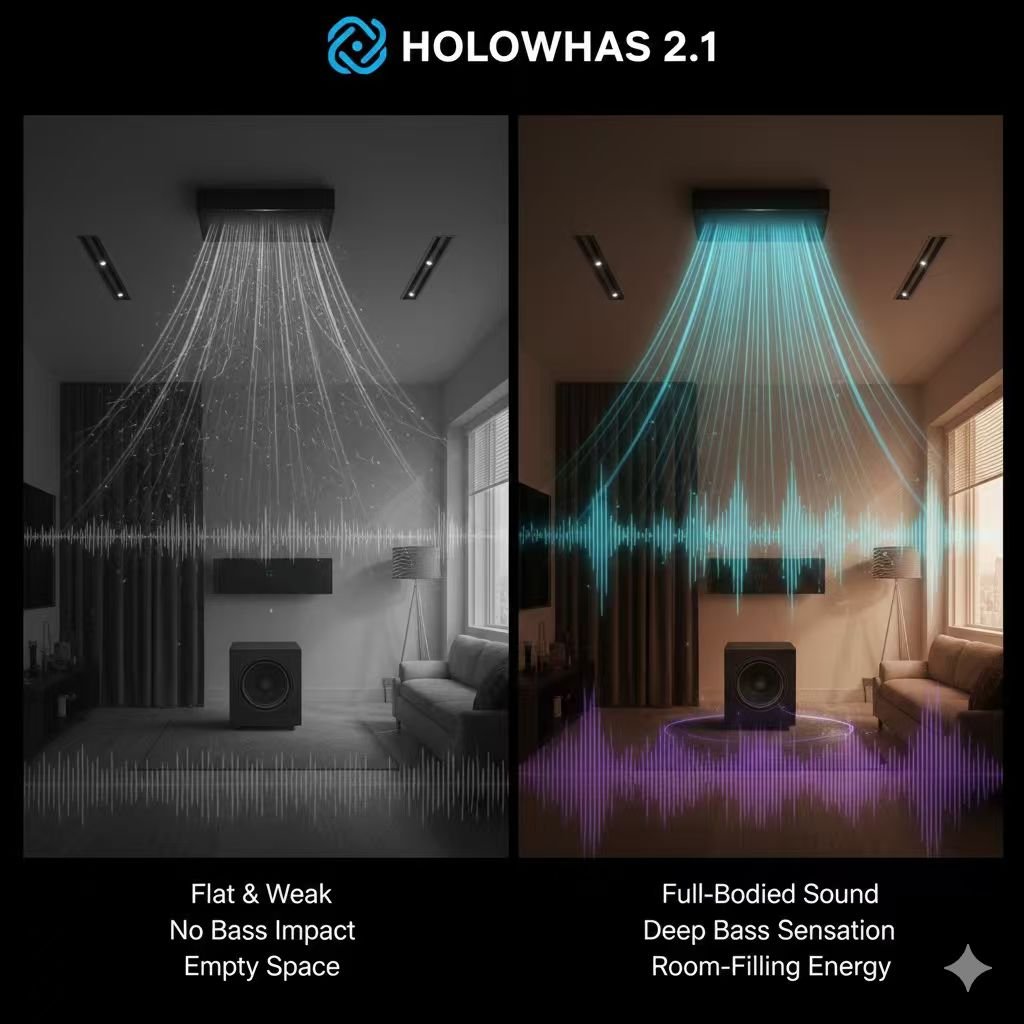
For decades, the multi-zone streaming amplifier market has been trapped in a “background music” mindset. Most industry-standard solutions offer only traditional 2.0 stereo outputs, assuming that ceiling speakers are merely meant for ambient noise.
However, as luxury residential design trends toward larger, open-concept spaces and users demand 192kHz lossless quality from platforms like Qobuz and Tidal, the limitations of 2.0 systems have become glaring. The OpenAudio HOLOWHAS Series is breaking this ceiling by introducing Native 2.1 Support across its multi-zone ecosystem.
1. The “Large Space” Dilemma: Why Stereo Falls Short
Modern architectural designs—featuring high ceilings, open kitchens, and expansive floor plans—create acoustic challenges that traditional 2.0 systems cannot solve:
- The Physics of Bass: To maintain a minimalist aesthetic, integrators often use 6.5-inch or 8-inch in-ceiling speakers. These drivers physically struggle to reproduce frequencies below 60Hz with any meaningful impact.
- Mid-Range Muddle: When 2.0 systems are pushed to fill a large room, the small drivers over-exert themselves trying to produce bass, leading to distortion and muddying the critical mid-range (vocals).
- Energy Gaps: In a room exceeding 400 sq. ft., stereo sound often feels “thin” and “bright,” failing to provide the visceral energy required for a premium listening experience.
2. The HOLOWHAS 2.1 Philosophy: Redefining Spatial Energy
The HOLOWHAS Series (Plus/Max) is not just about raw power; it is about intelligent power distribution. By supporting a Native 2.1 Configuration per zone, it transforms how music inhabits a home.
A. Advanced Bass Management
Unlike basic systems that simply parallel a signal, HOLOWHAS features sophisticated Digital Crossover Logic. It strips the heavy low-frequency load (typically below 80Hz) from the main architectural speakers and directs it to a dedicated subwoofer channel.
- The Result: The main speakers are “liberated,” allowing them to deliver crystal-clear highs and transparent mids, while the subwoofer handles the heavy lifting.
B. The “Invisible” High-Performance Setup
With 2.1 support, integrators can use smaller, completely discreet satellite speakers that disappear into the décor, paired with hidden in-wall or under-sofa subwoofers. This combo delivers a frequency response that rivals massive floor-standing speakers.
C. The 200W Authority (Max Series)
For truly massive environments, the HOLOWHAS Max provides 200W per channel. This ensures that even high-performance, power-hungry architectural subwoofers are driven with absolute grip, transient speed, and authority.
3. High-Fidelity Synchronization: 192kHz Precision
Why is HOLOWHAS the leader in this space?
- Microsecond Phase Alignment: Processing 8 concurrent streams of high-resolution audio is a feat of engineering. HOLOWHAS ensures that the .1 subwoofer channel is perfectly phase-aligned with the stereo mains. Without this precision, the bass feels detached and “slow.”
- Lossless Integrity: High-resolution audio (192kHz) contains vast amounts of spatial information. The 2.1 architecture preserves the dynamic range of the original recording, ensuring that music in a large room feels like a live performance, not a digital broadcast.
4. Engineered for the Modern Integrator: Control4, KNX & Home Assistant
HOLOWHAS integrates seamlessly into the smart home backbone, offering flexibility that 2.0 units cannot match:
- Dynamic Scenarios: Via Home Assistant or Control4, users can trigger “Morning Mode” (gentle 2.0 audio) or “Party Mode” (activating the .1 subwoofer and unleashing full 200W energy).
- Simplified Hardware Stack: Previously, achieving 2.1 in a multi-zone setup required external crossovers and extra amplifiers. HOLOWHAS consolidates this into a single, rack-efficient chassis, reducing cost and complexity.
Conclusion: 2.1 is the Foundation of the Modern Smart Home
If stereo (2.0) was the past of multi-room audio, 2.1 is its future. In high-stakes residential projects where the client demands both invisibility and impact, the HOLOWHAS Series stands alone.
By combining native 2.1 support with 192kHz lossless processing and massive power reserves, OpenAudio ensures that music isn’t just heard—it’s felt.



Carter
27 Jan, 2026Spot on. 2.1 is definitely the way to go if you actually care about audio quality in a multi-room system. It’s not just about more bass, it’s about that fuller sound. Thanks for sharing!