


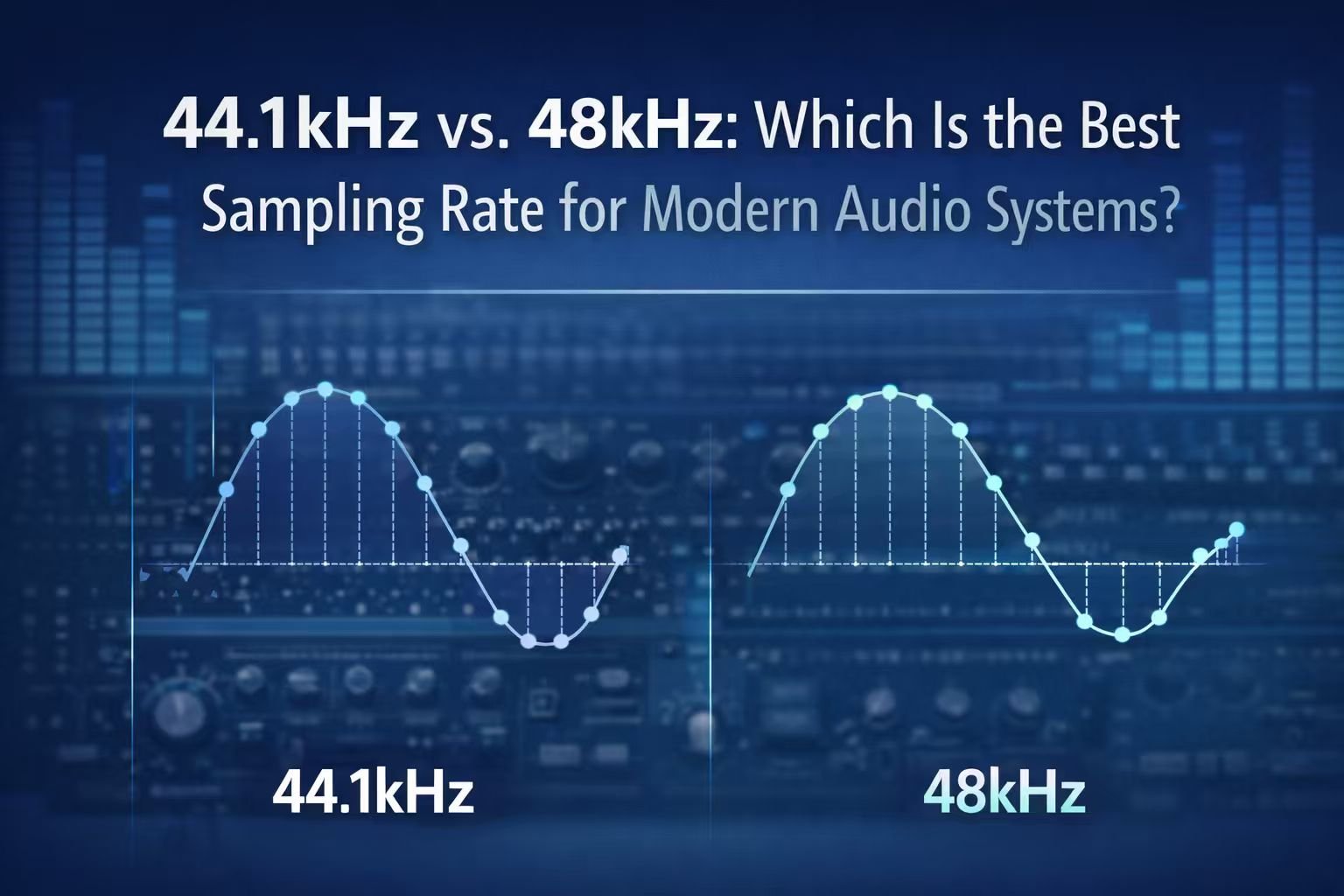
44.1kHz vs. 48kHz: Which Is the Best Sampling Rate for Modern Audio Systems?
For decades, 44.1kHz has been the default sampling rate for digital audio. Anyone involved in music production, recording, or CD mastering is familiar with this number.
However, with modern audio systems supporting 48kHz, 96kHz, and even 192kHz, many professionals now ask:
Is 44.1kHz still enough, or should we move to 48kHz and beyond?
In this article, we explain what sampling rate really means, examine the practical differences between 44.1kHz and 48kHz, and discuss how these choices affect real-world playback—especially in multi-room streaming systems and home audio platforms such as OpenAudio’s HOLOWHAS series.
What Is Sampling Rate?
Sampling rate refers to how many times per second an analog audio signal is measured and converted into digital data.
It is measured in kilohertz (kHz).
- 44.1kHz = 44,100 samples per second
- 48kHz = 48,000 samples per second
According to the Nyquist-Shannon Sampling Theorem, the highest frequency that can be captured is half of the sampling rate.
- 44.1kHz → captures up to 22.05kHz
- 48kHz → captures up to 24kHz
Since human hearing typically ranges from 20Hz to 20kHz, both formats already exceed what most listeners can perceive.
Why 44.1kHz Became the Original Standard
When Sony and Philips developed the Compact Disc in the early 1980s, they needed a sampling rate that:
- Covered the full human hearing range
- Worked with existing video-based digital recording systems
44.1kHz was chosen because it aligned cleanly with both:
- NTSC video (30 fps)
- PAL video (25 fps)
As CDs became dominant, 44.1kHz naturally became the global music standard—and remains the default for most music distribution today.
Is Higher Sampling Rate Always Better?
Not necessarily.
Diminishing Audible Returns
While higher sampling rates technically capture more data, the audible improvement between:
44.1kHz → 48kHz → 96kHz
is minimal for most listening scenarios.
Unless you are performing:
- Extreme time-stretching
- Heavy sound design
- Scientific or archival processing
Most listeners cannot reliably distinguish these differences.
CPU Load and Storage Impact
Higher sampling rates:
- Increase file sizes
- Increase processing load
- Reduce maximum track counts
In large multi-zone systems, efficiency and stability often matter more than extreme sampling rates.
Internal Oversampling in Modern Software
Most modern DAWs and DSP engines already use internal oversampling to reduce aliasing.
This means you can enjoy many benefits of high-rate processing while still operating at 44.1kHz or 48kHz.
Why 48kHz Is Popular in Video and AV Systems
48kHz has become the de facto standard for:
- Film
- Television
- Broadcast
- Video production
Because it aligns cleanly with video frame clocks and synchronization systems.
For installations involving:
- Home cinema
- AV receivers
- Multi-room audio synchronized with video
48kHz is often the safer choice.
Sampling Rate vs. Bit Depth
Sampling rate controls time resolution.
Bit depth controls dynamic range.
Common bit depths:
- 16-bit
- 24-bit
- 32-bit float
For professional work:
24-bit depth matters more than ultra-high sampling rates.
Typical high-quality combinations:
- 44.1kHz / 24-bit
- 48kHz / 24-bit
Both deliver excellent fidelity.
Ultrasonic Frequencies and Analog Hardware
Very high sampling rates (96kHz / 192kHz) introduce ultrasonic content above 20kHz.
While inaudible, this content can:
- Stress analog circuits
- Cause intermodulation distortion
- Increase amplifier workload
For many playback systems, this can actually reduce overall stability rather than improve sound quality.
Recommended Sampling Rates by Use Case
| Application | Recommended Rate |
| Music Recording | 44.1kHz or 48kHz |
| Music Mixing | Same as recording |
| Music Mastering | 44.1kHz or 48kHz |
| Streaming Services | 44.1kHz |
| Podcasting | 44.1kHz |
| Video / Film | 48kHz |
| Multi-Room Audio Systems | 44.1kHz or 48kHz |
Sampling Rate in Multi-Room and Whole-Home Audio Systems
In whole-home audio environments, priorities differ from studio production:
- Long-term stability
- Low latency
- Multi-zone synchronization
- Efficient DSP usage
Platforms such as OpenAudio’s HOLOWHAS series are designed around system-level digital audio pipelines, supporting standard professional sampling rates (44.1kHz and 48kHz) that ensure:
- Reliable multi-zone synchronization
- Low processing overhead
- Compatibility with streaming services and video sources
Rather than chasing extreme sampling rates, OpenAudio focuses on clean signal paths, stable clocks, and accurate digital routing, which have far greater real-world impact on perceived audio quality.
Does 48kHz Sound Better Than 44.1kHz?
In controlled tests:
- Differences are extremely subtle
- Often masked by speakers, room acoustics, and mastering quality
Speaker placement, room treatment, amplifier quality, and system architecture usually influence sound far more than sampling rate choice.
Should You Abandon 44.1kHz?
No.
44.1kHz remains:
- The standard for music distribution
- Fully capable of high-fidelity playback
However:
- If your system includes video → choose 48kHz
- If you want one universal format → 48kHz is a good modern choice
Both are excellent.
Final Thoughts
The best sampling rate is not the highest number—it is the one that best fits your workflow and system design.
For most professional and residential audio systems:
44.1kHz or 48kHz at 24-bit delivers outstanding sound quality.
Modern platforms like OpenAudio HOLOWHAS focus on system architecture, clock stability, multi-zone routing, and high-quality DSP, which ultimately define the listening experience far more than chasing extreme sampling rates.
In the end, listeners do not hear kilohertz numbers.
They hear music, space, and emotion.
Learn more about OpenAudio’s multi-room streaming platforms:
https://www.openaudio.io



wow201
27 Jan, 2026Clear and concise. It’s a classic debate, but understanding the math behind why 48kHz is winning out in modern digital setups helps a lot when configuring my DSP.
jamin
26 Jan, 2026Music platforms might make you pick a side, but playback devices should be all-around champions. Huge thanks to Open Audio for supporting Qobuz at 192kHz!