


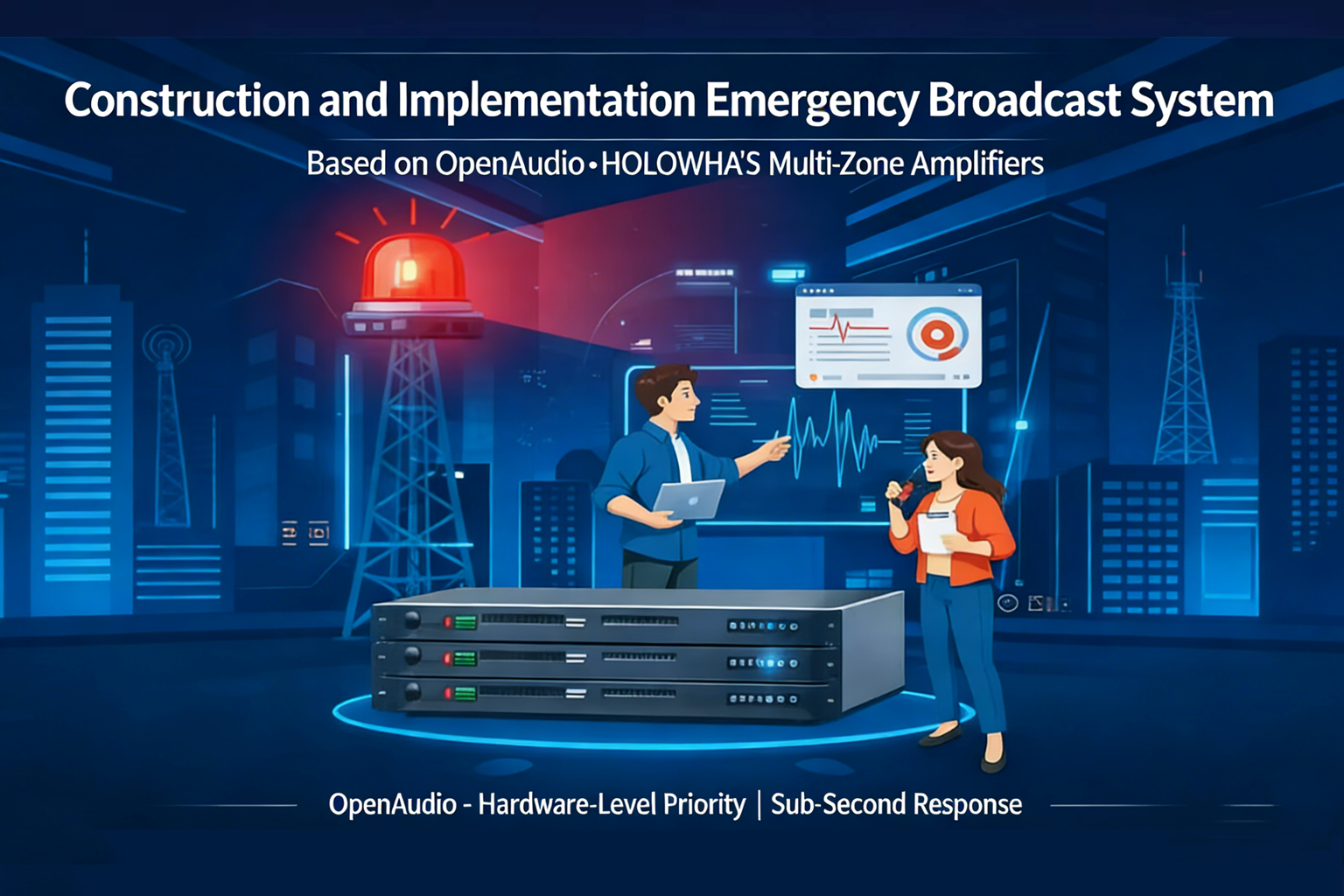
Based on OpenAudio HOLOWHAS Multi-Zone Amplifiers
Executive Summary
Emergency broadcasting is a mission-critical audio system responsible for delivering mandatory instructions and alerts during fires, earthquakes, security incidents, gas leaks, and other life-safety events. Unlike background audio or commercial PA systems, emergency broadcast systems must guarantee:
- Immediate response
- Absolute audio priority
- Full-area or zone-specific coverage
- Offline survivability
- Hardware-level reliability
OpenAudio HOLOWHAS multi-zone amplifiers provide an ideal hardware foundation for building professional emergency broadcast systems. By combining OpenAudio’s unified control architecture with HOLOWHAS’s multi-stream, multi-zone amplifier design and hardware-level source priority mechanisms, integrators can construct emergency broadcast systems that remain operational even when networks, controllers, or automation platforms fail.
This article provides a complete technical blueprint for designing, implementing, and maintaining emergency broadcast systems based on OpenAudio HOLOWHAS multi-zone amplifiers.
Design Philosophy: Hardware-First Emergency Execution
Most failures in emergency broadcast systems originate from excessive dependence on centralized software platforms.
The OpenAudio + HOLOWHAS approach follows a hardware-first execution philosophy:
- OpenAudio handles scheduling, logic, and integration
- HOLOWHAS amplifiers execute emergency audio locally at hardware level
Even if the control layer becomes unstable, HOLOWHAS amplifiers retain the ability to trigger emergency audio locally and enforce priority rules.
This architecture ensures emergency playback capability is never purely software-dependent.
Key Capabilities of HOLOWHAS for Emergency Broadcasting
HOLOWHAS multi-zone amplifiers offer several native features critical to emergency use:
2.1 Multi-Zone Independent Amplification
- Each zone has its own amplifier channel
- Zones can operate independently or in groups
- Emergency audio can target:
- Single zone
- Multiple zones
- Entire building
2.2 Multi-Source Audio Inputs
HOLOWHAS supports multiple audio sources:
- AirPlay 2
- Spotify Connect
- DLNA / UPnP
- Bluetooth
- Network streams
- Local USB storage
This allows emergency audio to originate from:
- Local stored files
- Network streams
- Real-time microphone input
2.3 Hardware-Level Priority Override
Emergency sources can be configured as highest priority inside HOLOWHAS firmware.
When emergency mode activates:
- All regular audio sources are forcibly muted
- Emergency audio takes exclusive control
- User volume settings are ignored
This happens inside the amplifier hardware, not in software.
2.4 Local Emergency Audio Storage
Emergency audio files can be stored on:
- HOLOWHAS internal storage
- USB flash drive
This enables offline emergency playback even if:
- Network is down
- Control server is offline
2.5 Preset Emergency Volume
HOLOWHAS can automatically switch to a predefined emergency volume level ensuring audibility even if zones were previously muted.
Role of OpenAudio Control Architecture
OpenAudio serves as the orchestration layer that:
- Receives triggers
- Applies logic
- Dispatches commands
It communicates with HOLOWHAS using standard IP-based control interfaces.
OpenAudio enables:
- External system integration
- Rule-based automation
- Remote management
- Monitoring and logging
However, OpenAudio does not replace HOLOWHAS emergency capability; it enhances it.
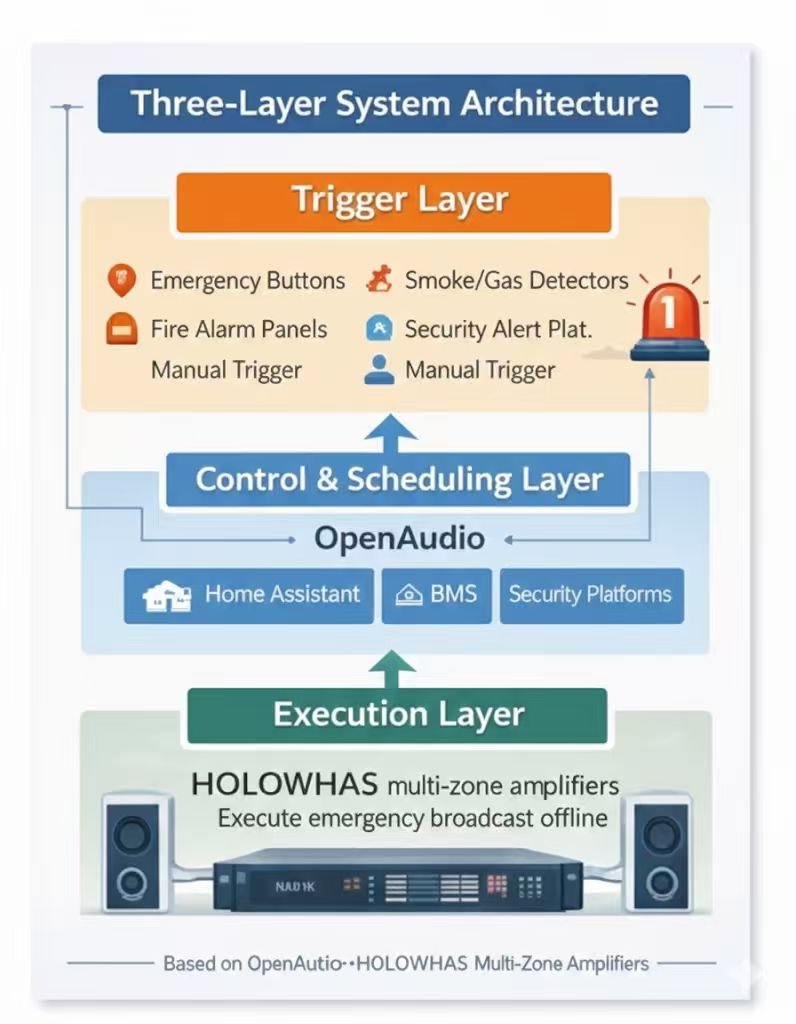
- Three-Layer System Architecture
The system is logically divided into three layers:
4.1 Trigger Layer
Sources that initiate emergency events:
- Physical emergency buttons
- Fire alarm panels
- Smoke detectors
- Gas sensors
- Security systems
- Weather alert platforms
- Manual commands from staff
4.2 Control & Scheduling Layer
- OpenAudio
- Optional integration with:
- Home Assistant
- Building Management Systems (BMS)
- Security platforms
4.3 Execution Layer
- HOLOWHAS multi-zone amplifiers
- Loudspeakers per zone
HOLOWHAS is always the final execution authority.
Trigger Methods
5.1 Local Physical Trigger
Emergency button wired to:
- IO module
- Controller
- Direct trigger interface
Activates emergency mode instantly.
5.2 Sensor-Based Trigger
- Smoke
- Temperature
- Gas
- Water leakage
Sensors report to OpenAudio or directly to HOLOWHAS trigger inputs.
5.3 External System API Trigger
Fire alarm system sends HTTP/MQTT command to OpenAudio.
5.4 Manual Remote Trigger
Authorized operator triggers emergency from dashboard or mobile interface.
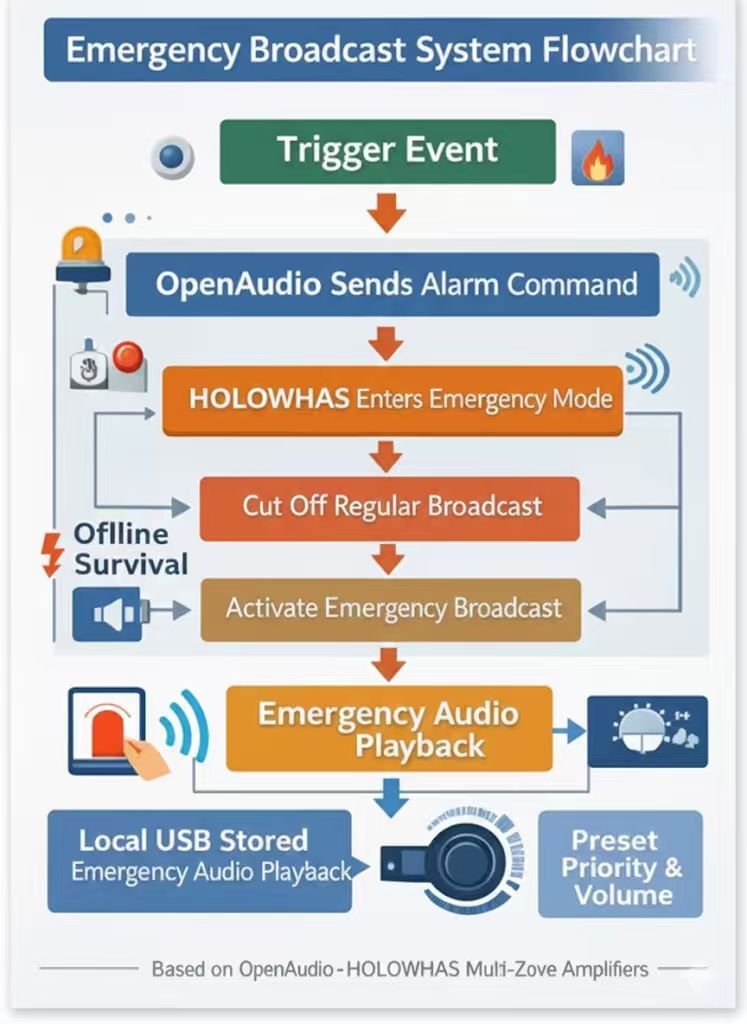
Emergency Audio Flow
- Trigger occurs
- OpenAudio sends emergency command
- HOLOWHAS enters emergency mode
- Regular audio is cut
- Emergency audio starts
- Preset volume enforced
If OpenAudio is offline:
- Local trigger activates HOLOWHAS directly
- USB emergency audio plays
Zone-Level Emergency Broadcasting
HOLOWHAS supports:
- Global emergency broadcast
- Floor-level emergency
- Room-level emergency
Examples:
- Fire in garage → Garage zone only
- Intruder in building → Entire building
- Gas leak in kitchen → Kitchen zone only
This prevents unnecessary panic.
Three Implementation Models
8.1 Basic Local Standalone System
Target: Homes, small shops, cafes
Components:
- HOLOWHAS amplifier
- USB emergency audio
- Emergency button
Features:
- No network required
- Hardware-only execution
Workflow:
Button → HOLOWHAS → Emergency Audio
8.2 Network-Integrated System
Target: Offices, schools, hotels
Components:
- HOLOWHAS
- OpenAudio controller
- Sensors
- Network connection
Features:
- Automatic triggers
- Zone selection
- Remote monitoring
8.3 Professional Redundant System
Target: Hospitals, campuses, commercial complexes
Additional components:
- UPS for HOLOWHAS
- Redundant OpenAudio controllers
- Real-time microphone
Features:
- Live voice announcements
- System health monitoring
- Event logging
Reliability Design
9.1 Dual Priority Protection
- OpenAudio software priority
- HOLOWHAS hardware priority
9.2 Offline Survival
- Local USB audio
- Local triggers
9.3 Power Backup
- UPS keeps amplifier alive
9.4 Sub-Second Command Response
- IP command < 300 ms
- Audio start typically < 2 seconds
Commissioning Checklist
- Verify emergency audio audibility
- Test zone mapping
- Test offline playback
- Test power loss recovery
- Verify priority override
- Document configuration
Application Scenarios
Hospitals
- Fire evacuation
- Code blue
- Hazard warnings
Hotels
- Fire
- Weather alerts
- Floor-specific evacuation
Bars & Clubs
- Fire
- Crowd control
Schools
- Lockdown
- Fire drills
- Evacuation
Why HOLOWHAS Is Ideal for Emergency Broadcasting
- Hardware-level execution
- Multi-zone native architecture
- Multi-source input flexibility
- Offline survivability
- Scalable
HOLOWHAS transforms emergency broadcasting from a fragile software feature into a robust hardware-backed safety system.



rosagrogrunt.ru
25 Jun, 2026Субстрат повсеместно применяется в сельском хозяйстве для производства растений. В теплицах грунт является базой для салатных растений. На плантациях земля задействуется для посева зерновых и масличных растений. <a href="https://rosagrogrunt.ru/krupnyj-opt/" rel="nofollow ugc">грунт оптом</a> Грунтовые смеси нужны для устройства лужаек и садового дизайна. В дендрариях земля играет главную функцию при производстве саженцев. Кроме того почва применяется для восстановления нарушенных земель.
проктолог-эксперт.рф
24 Jun, 2026Варикозное расширение вен прямой кишки — это частая патология, нуждающаяся незамедлительного лечения. Отсутствие симптомов или затягивание визита к специалисту может обернуться опасными осложнениями, такими как тромбоз. Текущая медицина предлагает разнообразные способы коррекции: от щадящих вмешательств до медикаментозной поддержки. <a href="https://xn----etbhrcdtbbfidklik5p.xn--p1ai/vypadenie-pryamoj-kishki/" rel="nofollow ugc">выпадение прямой кишки симптомы</a> Ранняя терапия даёт возможность эффективно купировать дискомфортные проявления и восстановить качество жизни. При возникновении начальных симптомов (зуд, жжение, кровянистые выделения) важно как можно скорее записаться к врачу-проктологу для обследования. Правильное лечение не только избавляет от телесного дискомфорта, но и предотвращает развитию заболевания и потребности в хирургическом вмешательстве.
Sam
27 Jan, 2026People always overlook the EBS part of a project until it’s too late. Thanks for the breakdown on the compliance side—super helpful for commercial installers.
Full
26 Jan, 2026Ideally, every home needs an emergency broadcasting system for safety and evacuation. So grateful to OpenAudio for making this a reality.
David w
26 Jan, 2026Excellent