


As global audio consumption shifts toward streaming platforms and on-demand services, many observers assume that broadcast-based technologies are inevitably approaching obsolescence. Yet across Europe, DAB+ amplifiers continue to maintain a stable and often underestimated market presence.
This persistence is not accidental. It is the result of Europe’s unique broadcasting infrastructure, regulatory environment, commercial usage patterns, and engineering priorities. More importantly, DAB+ amplifiers are no longer viewed as legacy products, but as foundational building blocks within hybrid audio distribution systems.
Europe Has the World’s Most Mature DAB+ Ecosystem
Europe is the global epicenter of Digital Audio Broadcasting (DAB+).
Several countries have already completed, or are close to completing, national transitions from FM to DAB+:
- Norway has effectively shut down national FM broadcasting
- The UK, Germany, Switzerland, Italy, and the Netherlands maintain extensive nationwide DAB+ coverage
- New vehicles sold within the European Union are generally required to support DAB+ reception
This level of infrastructure maturity fundamentally changes how DAB+ is perceived.
In Europe, DAB+ is not an emerging technology—it is a basic utility.
Just as AM/FM remains a baseline feature in North America, DAB+ functions as a standard broadcast layer across Europe. Where broadcast exists, reception devices are required. Where reception devices exist, amplification and distribution systems naturally follow.
Broadcasting in Europe Is a Public-Service Backbone
European broadcasting models differ significantly from purely commercial systems.
Public broadcasters play a dominant role and are tasked with delivering:
- News and public information
- Cultural programming
- Traffic and safety updates
- Emergency announcements
This public-service orientation gives broadcast radio a structural importance beyond entertainment.
As a result, many types of buildings routinely integrate broadcast audio systems:
- Shopping centers
- Supermarkets
- Schools and universities
- Hospitals
- Transportation hubs
- Government facilities
- Hotels and office buildings
These environments require audio systems that are:
- Always available
- Simple to operate
- Stable over long periods
DAB+ amplifiers fit these requirements precisely.
Commercial Spaces Still Rely Heavily on Live Radio
In many European commercial installations, background audio is still primarily sourced from broadcast radio rather than streaming services.
Common reasons include:
- No account management
- No subscription dependency
- No content licensing administration
- Instant startup and predictable behavior
A typical architecture remains:
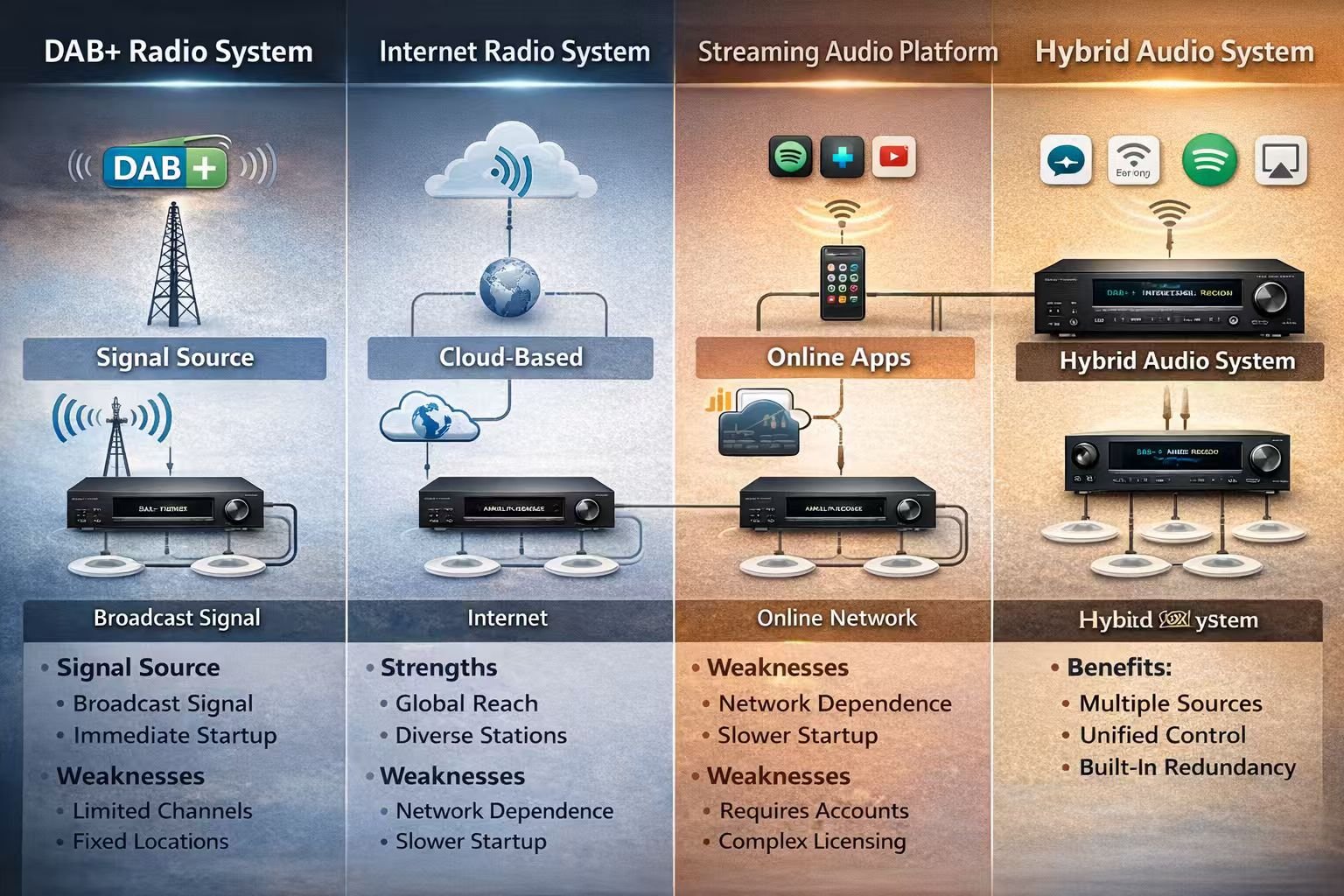
DAB+ Tuner → Multi-Zone Amplifier → Distributed Loudspeakers
Millions of such systems were installed over the past decade. Today, many are reaching upgrade or replacement cycles, sustaining ongoing demand for DAB+ capable amplifiers.
Reliability Outweighs Feature Richness in Professional Installations
Professional integrators evaluate technologies differently from consumers.
Key priorities include:
- Deterministic behavior
- Low failure probability
- Minimal maintenance
- Independence from external network conditions
From this perspective:
Broadcast reception provides a level of operational certainty that purely IP-based streaming cannot guarantee.
Even in modern installations, many system specifications explicitly require that:
“Basic audio must remain available if the network connection fails.”
DAB+ naturally satisfies this requirement.
Regulatory and Compliance Drivers
In certain European jurisdictions, public buildings are mandated to support emergency broadcast reception.
DAB+ is frequently listed among acceptable input sources.
This creates a form of policy-driven baseline demand that is largely immune to consumer trend cycles.
The Real Role of DAB+ Amplifiers Today
DAB+ amplifiers in Europe are primarily:
- Infrastructure devices
- Commercial and institutional tools
- Long-life system components
They are not positioned as audiophile products or lifestyle gadgets.
Their value lies in predictability, longevity, and integration simplicity.
The Market Is Evolving Toward Hybrid Architectures
The most important shift is not the disappearance of DAB+, but its integration into broader multi-source platforms.
Modern amplifiers increasingly combine:
- DAB+ tuners
- Internet radio
- Local media playback
- Network streaming technologies
This creates a hybrid audio core capable of selecting the optimal source for each use case.
Broadcast becomes one layer inside a larger ecosystem rather than a standalone endpoint.
Why This Hybrid Model Works
Hybrid systems allow integrators to:
- Use DAB+ for news, talk, and emergency content
- Use streaming services for music
- Maintain redundancy across sources
From a system-design standpoint, this is far superior to relying on any single delivery mechanism.
Conclusion
DAB+ amplifiers still matter in Europe because broadcasting itself still matters in Europe.
Not as a nostalgic format, and not as a consumer trend, but as a functional pillar of public audio infrastructure.
As long as Europe continues to treat broadcast radio as a core public service, DAB+ capable amplification will remain relevant.
The future is not broadcast versus streaming.
The future is broadcast plus streaming—unified inside hybrid audio platforms.



Adams
27 Jan, 2026Spot on. Even with Spotify and Tidal everywhere, DAB is still the gold standard for reliable, high-quality radio in Europe. Glad to see someone’s still innovating in this space.
Denial
26 Jan, 2026Great insights on why DAB+ remains relevant! The hybrid approach broadcast for reliability/emergencies plus streaming for flexibility makes perfect sense. Europe’s public-service broadcasting model ensures DAB+ amplifiers remain a core piece of infrastructure, not legacy tech.