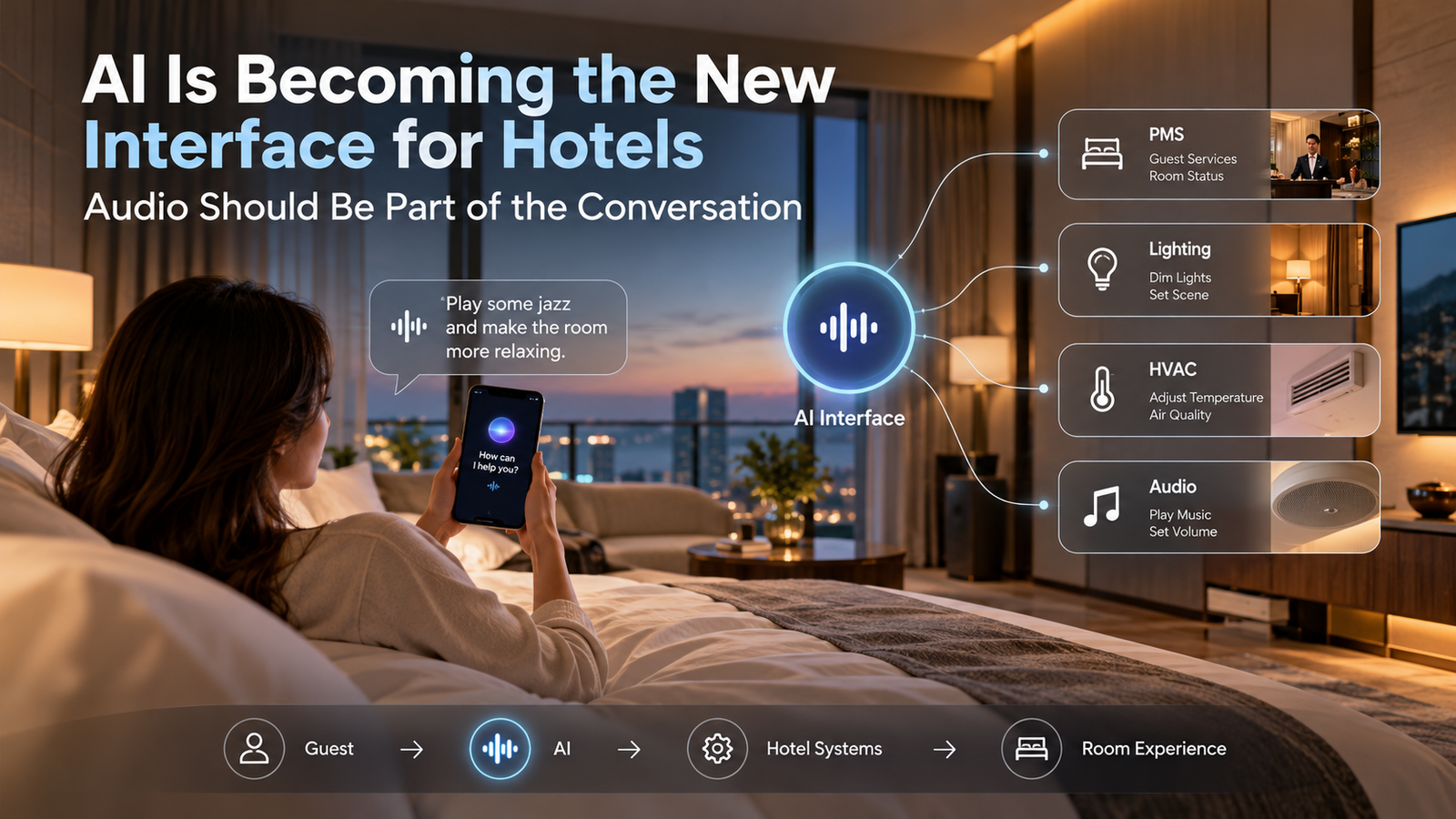
AI Is Becoming the New Interface for Hotels — Audio Should Be Part of the Conversation
The AI Hospitality Alliance (AIHA) recently released its AI Orchestration Framework for Hospitality, outlining a practical architecture for connecting AI agents with the systems that operate a modern hotel.
The framework proposes a shared integration and control layer between AI agents and hotel systems, allowing different AI interfaces to access information and initiate actions while existing hotel systems retain authority over their own data and operations.
It is an important direction for hospitality technology.
But it also raises another question:
As AI becomes a new interface for the hotel, what other hotel systems should eventually become part of this connected environment?
At OpenAudio, we believe audio should be part of that conversation.
From Answering Questions to Controlling the Guest Environment
Much of the first wave of hospitality AI has focused on information.
A guest asks:
“What time is breakfast?”
“Can I have a late checkout?”
“Is the spa available this afternoon?”
The next stage is different.
AI will increasingly be expected not only to answer questions, but also to interact with the physical hotel environment.
The AIHA framework already recognizes this broader direction by considering building systems and coordinated actions alongside core hospitality platforms.
For the guest, however, the hotel experience is not divided into PMS, GRMS, AV, lighting and HVAC systems.
It is simply the room.
A guest may eventually say:
“Make the room more relaxing.”
“Lower the temperature and dim the lights.”
“Play some jazz.”
“Turn the music down.”
“Stop the music when I leave.”
For these experiences to work, AI needs a secure and deterministic path to the systems that actually control the physical environment.
Audio Is Already a Networked Hotel System
Modern hotel audio is increasingly software-defined and network-connected.
In a guest room, audio may include AirPlay 2, Google Cast, network streaming, room control integration and hotel automation.
In public areas, restaurants, lounges, pools and other shared spaces, commercial audio systems increasingly combine network streaming, DSP, matrix routing, amplification and centralized control.
This means audio no longer needs to exist as an isolated AV subsystem.
With the appropriate APIs and integration architecture, it can become another controllable service within the hotel technology ecosystem.
What This Could Look Like
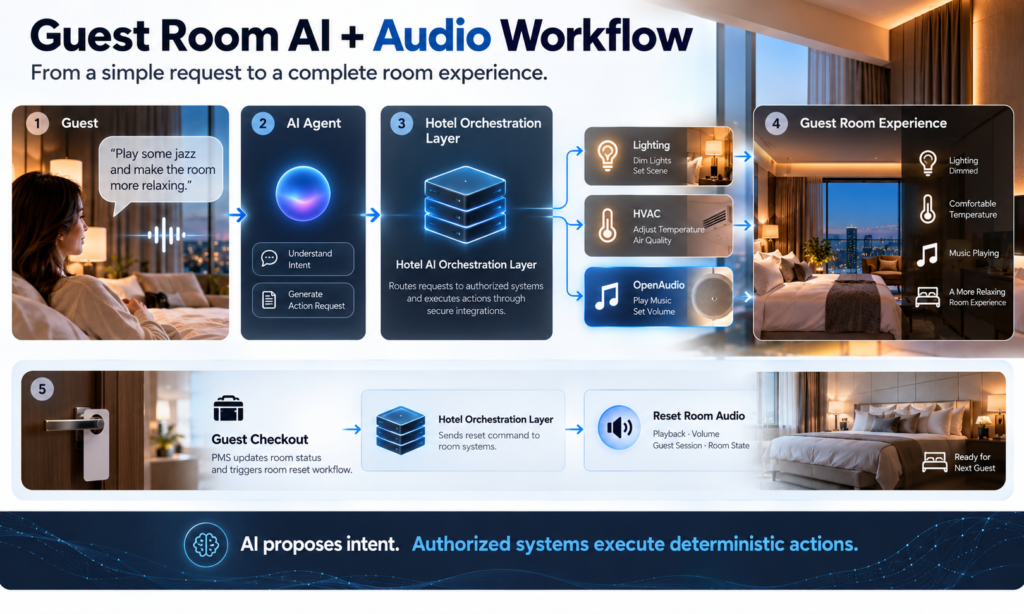
Consider a future guest-room workflow.
A guest checks in.
The PMS confirms the assigned room.
The hotel orchestration layer establishes the appropriate guest and room context.
The room environment is prepared.
Lighting and temperature settings are initialized, and the room audio system becomes available for the guest’s stay.
During the stay, an authorized guest-facing AI agent could send a request through the hotel’s orchestration layer to the audio platform:
Guest → AI Agent → Hotel Orchestration Layer → Audio API → Guest Room Audio
The same principle could apply at checkout.
The room audio environment could be reset for the next guest, helping prevent previous guest sessions, playback states or personalized settings from remaining active.
The important principle is the same one emphasized by the AIHA framework:
AI should express intent, while authorized and deterministic systems execute the action.
Where OpenAudio Fits
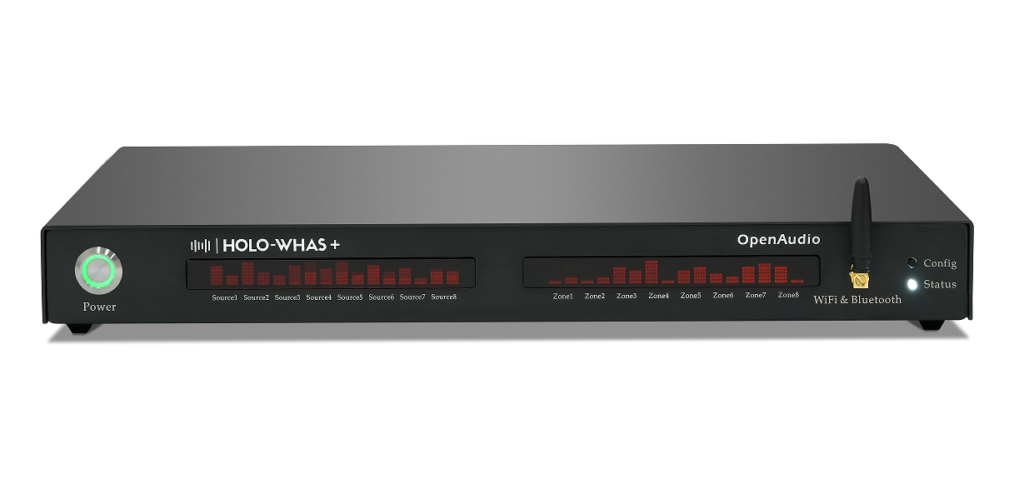
OpenAudio has been developing its audio platform around this connected model.
For hotel guest rooms, OpenAudio supports AirPlay 2 and Google Cast, giving guests familiar ways to bring their own music into the room.
For private villas and branded residences, the platform can provide 8 independent AirPlay 2 streams and 8 independent Google Cast streams, allowing different users and rooms to play different content simultaneously.
For hotel public areas, OpenAudio provides 70V/100V commercial audio solutions integrating network streaming, DSP, matrix routing and amplification.
Across these applications, integration is an important part of the platform.
OpenAudio supports native KNX integration and provides interfaces for integration with automation and third-party systems, including Web API-based control.
This creates an opportunity for audio to participate in a broader hotel technology architecture rather than remain a standalone system.
The Hotel Technology Stack Is Expanding
The significance of AI orchestration is not simply that hotels can deploy more AI agents.
It is that the interface between the guest and the hotel is changing.
Web chat, mobile applications, voice interfaces and AI assistants may increasingly become different front ends to the same hotel infrastructure.
Behind them, the hotel still needs reliable systems that can expose their capabilities securely, report their state and execute authorized actions predictably.
PMS, CRM, payments, maintenance and building systems are part of that infrastructure.
We believe audio should be as well.
The AI Hospitality Alliance’s new framework is an important step toward defining how these systems can work together.
As hospitality AI moves from answering questions to interacting with the physical guest environment, the conversation will increasingly need to include the systems guests actually see, hear and experience.
Audio is one of them.
Please visit the official website www.openaudio.io