


Introduction
For more than two decades, the smart home industry has pursued one elusive goal: unification.
Unification of protocols.
Unification of ecosystems.
Unification of device control.
Unification of user experience.
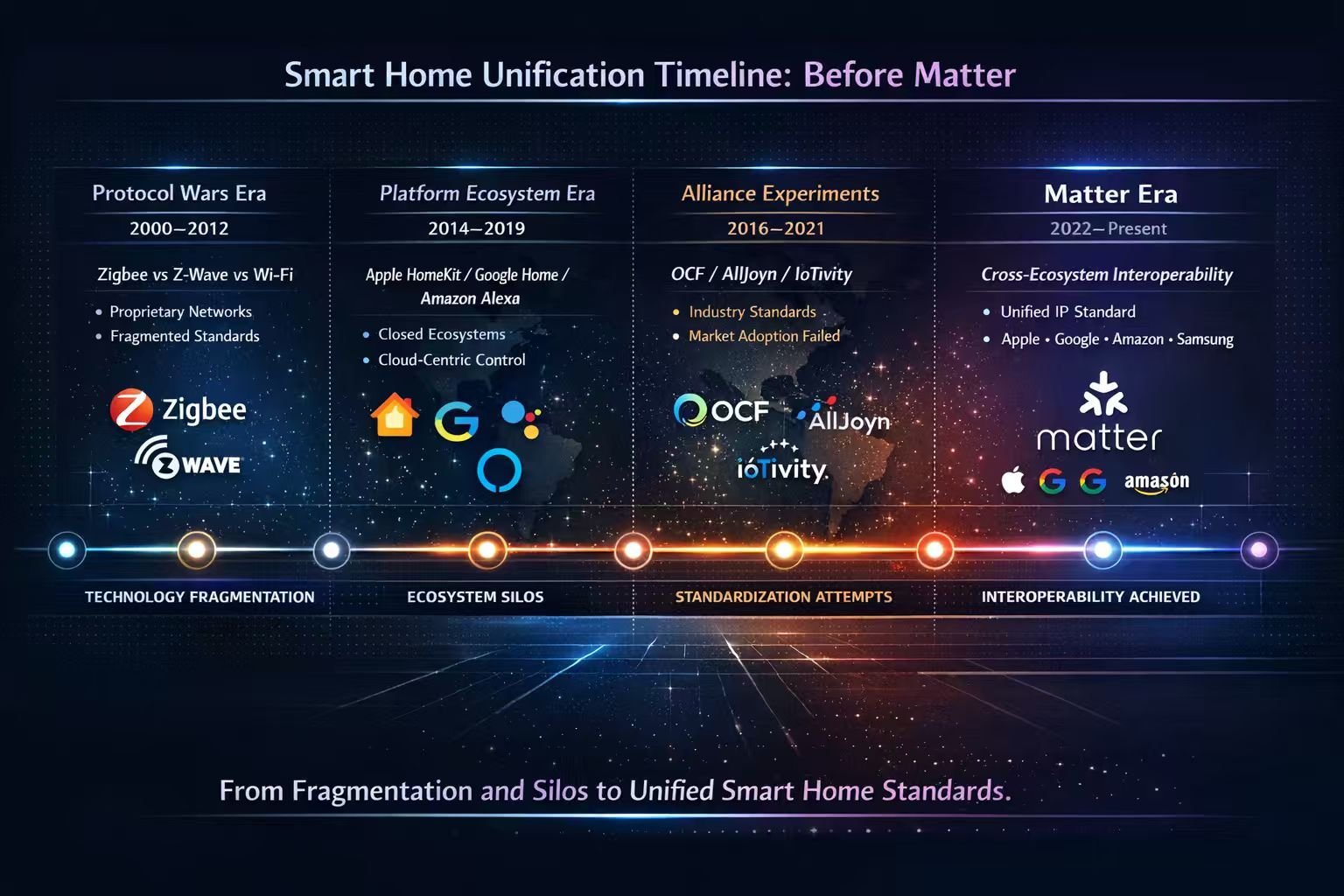
Matter did not emerge in a vacuum. It is the fourth major structural attempt at solving fragmentation. To understand its significance, we must examine the three generations that came before it—and why each ultimately failed.
I. The Protocol Wars Era (2000–2012)
Zigbee vs Z-Wave vs Wi-Fi
The first wave of “unification” focused purely on wireless transport protocols.
Zigbee introduced low-power mesh networking.
Z-Wave optimized sub-GHz reliability.
Wi-Fi offered bandwidth but consumed power.
Each protocol attempted to become the backbone of the smart home.
Why It Failed
- Commercial fragmentation
Each alliance operated independently.
Interoperability between Zigbee and Z-Wave did not exist. - Hub dependency
Every ecosystem required its own gateway. - No application layer standardization
Even devices on the same protocol often used different command structures.
The industry unified transport—but not behavior.
This era unified radio technology, not user experience.
II. The Platform-Centric Era (2014–2019)
Apple HomeKit, Google Home, Amazon Alexa
The second wave shifted focus from radio protocols to platform ecosystems.
Voice assistants became the new center of gravity.
Apple prioritized security and certification.
Google emphasized AI and cloud intelligence.
Amazon scaled through device compatibility and cost leadership.
Each platform attempted to unify the smart home by owning the control layer.
Why It Failed
- Closed ecosystems
Devices certified for one platform were often incompatible with others. - Cloud dependency
Automation relied heavily on remote servers. - Competitive hostility
No major platform wanted to cooperate structurally.
This era unified user interface—but not device interoperability.
The smart home became platform-centric, not standard-centric.
III. The Alliance Experiments (2016–2021)
OCF, AllJoyn, IoTivity
The third attempt came from industry alliances.
Open Connectivity Foundation (OCF)
AllJoyn (backed by Qualcomm)
IoTivity
These initiatives aimed to create an open, vendor-neutral device model.
Technically ambitious. Architecturally elegant.
Why They Failed
- Lack of big-tech alignment
Apple, Google, and Amazon were not fully aligned. - Enterprise-oriented design
Too complex for consumer-scale adoption. - No enforcement power
Certification lacked real market leverage.
They unified vision—but not market momentum.
IV. The Matter Era (2022–Present)
Matter represents the first time:
Apple
Google
Amazon
Samsung
CSA
all agreed to co-author the same device model and interoperability rules.
This is fundamentally different from previous attempts.
Matter standardizes:
- Device Types
• Clusters
• Data Models
• Commissioning
• Security
• Transport over IP
Unlike Zigbee or Z-Wave, Matter is not just a radio protocol.
Unlike HomeKit or Alexa, it is not a platform silo.
Unlike OCF, it has enforcement through ecosystem integration.
For the first time, unification occurs at the application layer and ecosystem layer simultaneously.
V. Structural Evolution of Smart Home Architecture
| Era | Core Center | Unification Target | Failure Mode |
| Protocol Wars | Wireless Radio | Transport | Fragmentation |
| Platform Wars | Voice Assistant | UI Control | Ecosystem Lock-in |
| Alliance Phase | Industry Standard | Data Model | Weak Adoption |
| Matter Era | Device Model | Interoperability | TBD |
Smart home architecture has evolved:
Hub-centric → Platform-centric → Cloud-centric → IP-native + Device-model-centric
VI. Why Matter Is Structurally Different
Matter succeeds not because it is technically superior, but because:
- It removes competitive disadvantage.
- It lowers integration cost.
- It preserves platform differentiation at the experience layer.
- It aligns incentives across giants.
It does not eliminate competition.
It shifts competition upward—from compatibility to intelligence.
This is a profound structural shift.
VII. The Next Phase: Post-Matter Competition
Matter solves baseline interoperability.
The next battlefield moves to:
- AI-native automation
• Immersive audio integration
• Whole-home orchestration
• Edge + cloud hybrid intelligence
• Media-centric smart environments
The industry is entering a phase where compatibility is assumed—and intelligence becomes the differentiator.
Conclusion
The history of smart home unification is not a straight line toward progress. It is a series of structural experiments.
Zigbee unified radio.
HomeKit unified interface.
OCF unified theory.
Matter unifies device behavior.
For the first time, the smart home industry is not arguing about how devices connect—but about how intelligently they operate.
The fragmentation era is ending.
The intelligence era has begun.
Industry Implementation: OpenAudio as a Certified Multi-Room Pioneer
As the smart home industry finally enters the era of true interoperability, real-world implementation becomes the decisive factor.
OpenAudio’s full product lineup — HOLOWHAS Ultra, Plus, Max, Ultra-GC, Plus-GC and related models — has obtained Matter certification and delivers full ecosystem compatibility across leading global platforms.
OpenAudio products natively support:
- Google Home
- Apple Home
- Amazon Alexa
- Samsung SmartThings
This cross-platform interoperability ensures seamless multi-room audio deployment in residential, commercial, and integrator-grade environments.
Rather than being locked into a single ecosystem, OpenAudio enables:
- Unified voice control across platforms
- Stable cross-brand device integration
- Multi-zone synchronized streaming
- Long-term future-proof architecture
OpenAudio represents a new category in smart home infrastructure:
Matter-certified, ecosystem-agnostic, network-native multi-room audio.
Learn more at:
www.openaudio.io


