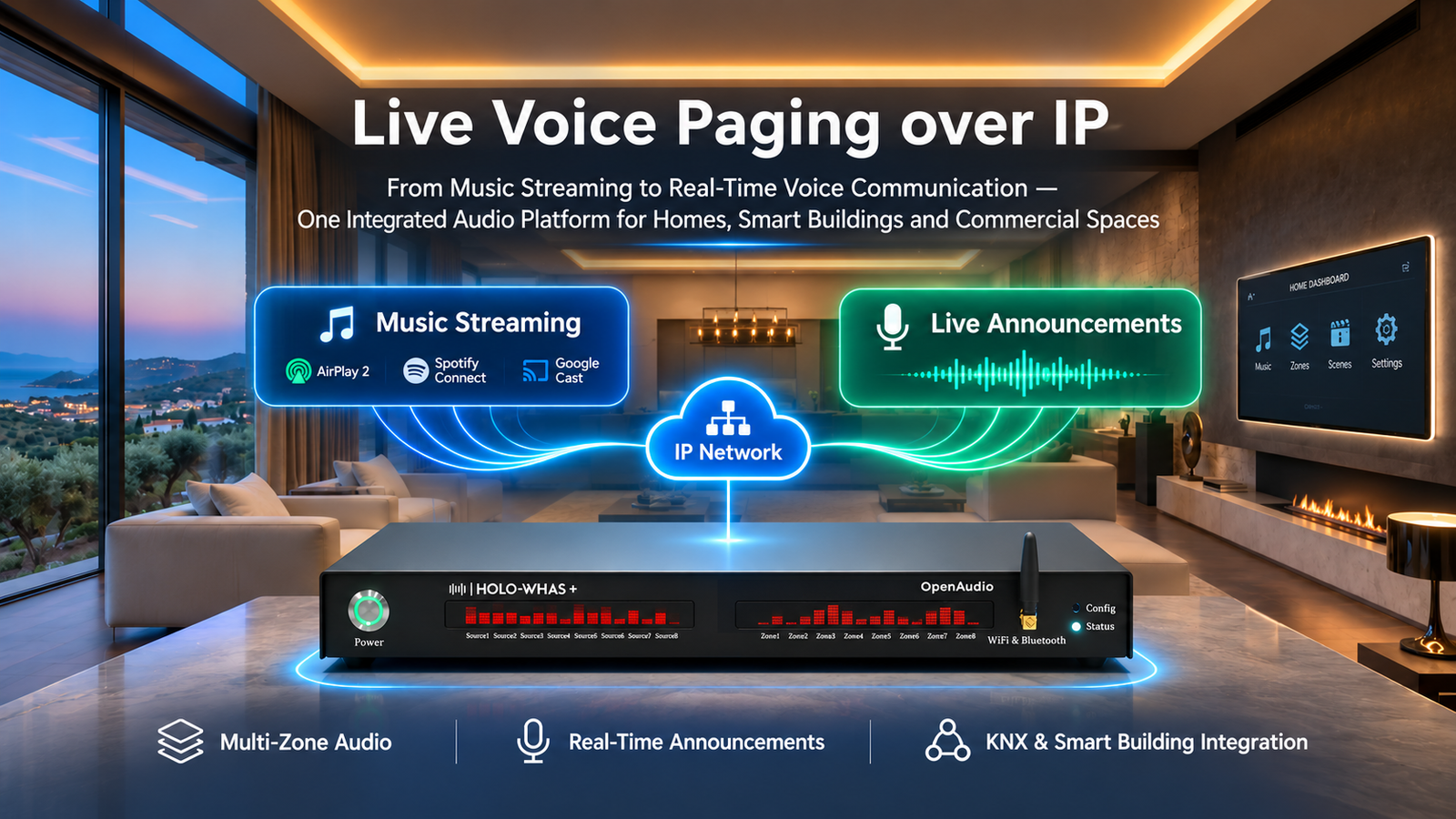
OpenAudio Brings Live Voice Paging over IP to Its Entire Streaming Audio Product Line
From Music Streaming to Real-Time Voice Communication — One Integrated Audio Platform for Homes, Smart Buildings and Commercial Spacesf
OpenAudio continues to expand the capabilities of its network-based audio platform with Live Voice Paging over IP, bringing real-time voice communication into the same infrastructure used for music streaming and multi-room audio distribution.
Designed for the entire OpenAudio streaming audio product family, this capability extends the role of streaming amplifiers and audio players beyond music playback, enabling them to serve as endpoints for live voice announcements across residential and commercial environments.
The concept is simple: the same audio system that delivers music throughout a property can also deliver live voice announcements when needed.
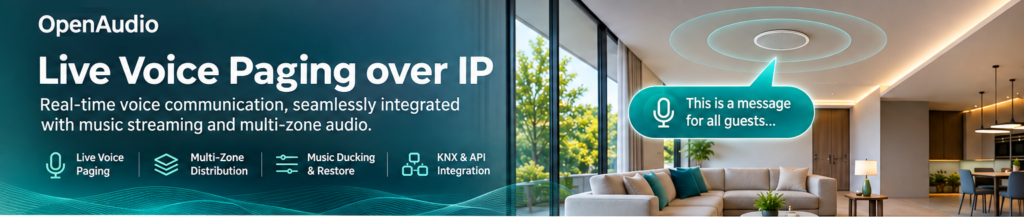
1. From Music Playback to Live Voice Communication
Traditional multi-room audio systems are primarily designed to distribute music from streaming services or local audio sources.
However, modern smart homes and connected buildings increasingly require audio systems to do more.
A homeowner may want to make an announcement to family members in another room. A hotel operator may need to communicate with staff in designated areas. A retail manager may want to address employees without installing a completely separate paging system.
Live Voice Paging over IP extends the existing audio infrastructure to support these scenarios.
Using an IP network, live voice audio can be transmitted from a compatible microphone application or external audio source to an OpenAudio device, where it is reproduced through the connected speakers.
Depending on the system configuration, announcements can be directed to a single room, selected zones, or multiple areas.
No separate voice synthesis engine is required. The system transmits and reproduces live human speech.
2. One Capability Across the OpenAudio Product Family
Live Voice Paging over IP is designed as a platform-level capability rather than a feature tied to one particular amplifier or mobile application.
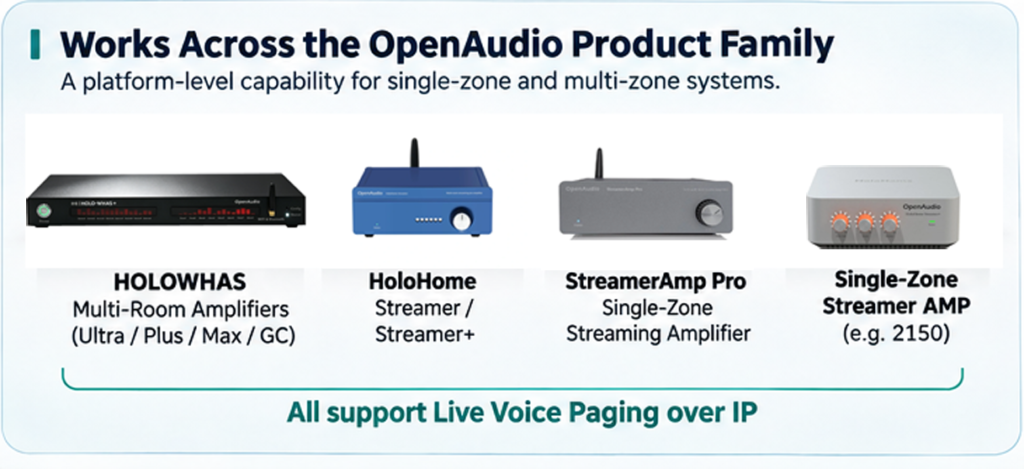
The architecture covers OpenAudio‘s streaming audio portfolio, including:
- HOLOWHAS Multi-Room Streaming Amplifiers, including HOLOWHASUltra, HOLOWHAS Plus, HOLOWHAS Max and the Google Cast variants HOLOWHAS Ultra-GC and HOLOWHAS Plus-GC.
- HoloHome Streamerand Streamer+, providing network audio capabilities for external amplification systems.
- StreamerAmp Proand Single-Zone Streaming Amplifiers, extending live voice communication to individual rooms and smaller installations.
- Compatible multi-zone audio systems, supporting voice distribution across independently controlled speaker zones.
The same underlying voice streaming mechanism can serve different system configurations.
A single-zone device can reproduce an announcement in one room, while a multi-zone amplifier can distribute the announcement to multiple selected areas.
This unified approach simplifies integration and provides a consistent foundation for system integrators working with different OpenAudio products.
3. How Live Voice Paging over IP Works
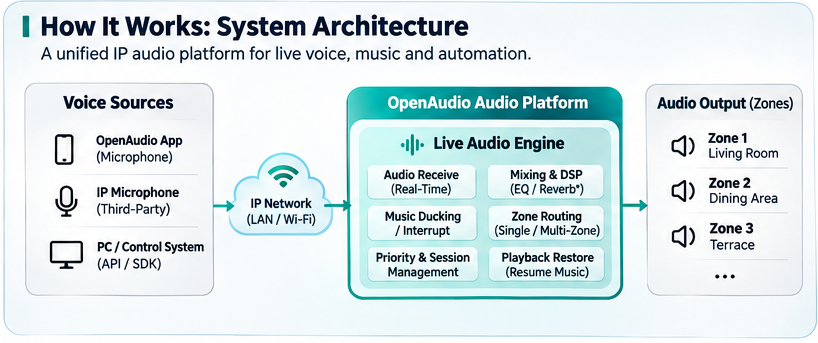
The architecture is built around three essential components:
Voice Source → IP Network → OpenAudio Audio Endpoint
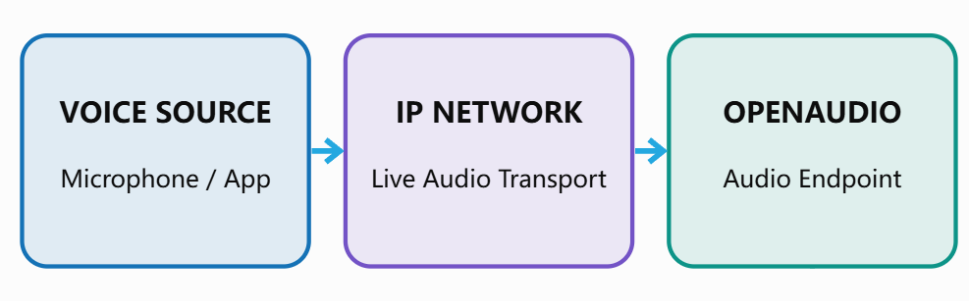
A compatible application or microphone source captures live speech and transmits the audio over the local IP network.
The OpenAudio device receives the audio stream, processes it and routes it to the appropriate audio output.
The amplifier or external amplification system then reproduces the announcement through the connected loudspeakers.
The underlying architecture separates three functions:
Voice Capture: Handled by a compatible mobile application, microphone interface or third-party software.
Audio Transport: Live audio is delivered over the IP network.
Audio Playback and Routing: The OpenAudio platform receives the voice stream and directs it to the selected output or zones.
This separation allows the audio infrastructure to support different applications without requiring every function to be built into a proprietary mobile app.
4. Voice Announcements Alongside Music
One of the most valuable aspects of an integrated voice paging platform is its ability to coordinate announcements with normal music playback.
In a typical installation, background music may already be playing through AirPlay 2, Spotify Connect, Google Cast or another audio source.
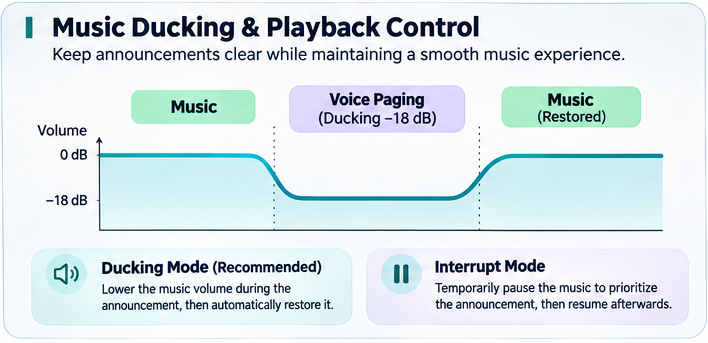
A paging-capable system can be designed to manage incoming voice audio through two operating modes:
Music Ducking
The background music volume is temporarily reduced while the announcement is played. Once the announcement finishes, the previous volume is restored.
Music Interruption
The system temporarily interrupts or mutes background audio to prioritize the voice announcement, then restores normal operation afterward.
These capabilities help ensure that voice announcements remain intelligible without requiring users to manually switch audio sources and adjust volume levels.
The specific mixing and restoration behavior depends on the device’s audio processing architecture and firmware implementation.
5. Integration with KNX and Smart Building Automation
OpenAudio‘s native KNXnet/IP integration provides a foundation for incorporating audio into professional smart home and building automation systems.
Live Voice Paging over IP creates opportunities to extend that integration beyond conventional music control.
For example, a KNX wall panel or automation event could be used to initiate a predefined paging workflow.
A smart building application could select the intended announcement zone, initiate a voice session and manage the audio system’s operating state.
Similarly, integrations through REST API, Home Assistant or other supported automation platforms could enable paging functions to participate in broader building workflows.
The key architectural principle is that voice transport and voice control are separate functions.
KNX and automation systems can manage when and where announcements are delivered, while the IP audio subsystem handles the actual voice transmission.
This approach avoids requiring KNX telegrams to carry real-time audio data.
6. Applications Across Residential and Commercial Environments
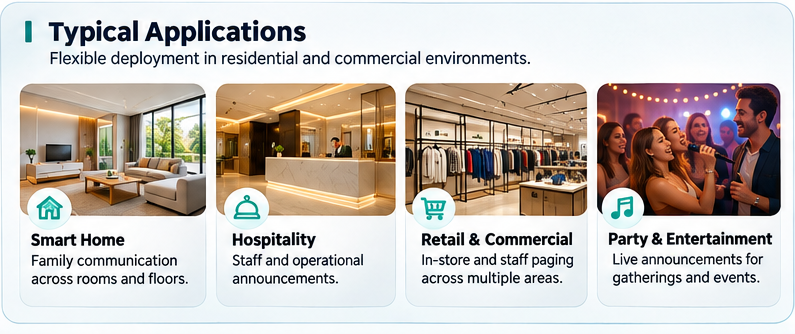
Smart Homes and Premium Residences
Live voice paging can help homeowners communicate across large residences without relying on separate intercom speakers in every room.
Typical scenarios include calling family members to dinner, communicating between different floors or making announcements to outdoor entertainment areas.
Villas and Multi-Zone Properties
Large villas often feature independent audio zones covering bedrooms, living spaces, terraces, gardens and recreational areas.
An integrated paging system can extend communication across these areas using the existing distributed audio infrastructure.
Hotels and Hospitality
Hotels and hospitality properties can use network audio infrastructure for staff communication, operational announcements and designated non-emergency paging applications.
For properties already equipped with distributed background music, combining music and voice communication within one coordinated platform may simplify system architecture.
Retail and Commercial Buildings
Retail stores, showrooms, offices and commercial facilities can benefit from voice announcements delivered through existing speaker systems.
Potential applications include staff notifications, customer-service announcements and operational communication.
Entertainment and Party Environments
Live voice streaming can also support informal announcements during private gatherings and entertainment events.
Hosts may use the audio system to address guests across multiple areas without requiring a dedicated public-address installation.
Low-latency performance and microphone-to-speaker synchronization must be evaluated separately for interactive singing or karaoke applications.
7. Beyond a Proprietary App: An Integration-Oriented Architecture
For OpenAudio, the long-term value of Live Voice Paging over IP lies in its platform architecture.
A proprietary application can provide a convenient user interface for selecting rooms and transmitting voice audio.
However, the underlying capability should remain accessible to compatible integration systems.
By separating the user interface from the audio transport and playback engine, the platform can accommodate different control methods and application requirements.
This approach aligns with OpenAudio’s broader development direction: combining streaming, amplification, audio routing and smart building integration into a connected audio infrastructure.
For professional system integrators, this creates opportunities to build customized workflows around the same hardware platform.
8. A More Versatile Audio Infrastructure
As connected buildings evolve, audio systems are increasingly expected to participate in daily communication and automation rather than operate only as entertainment devices.
Live Voice Paging over IP represents an important extension of the OpenAudio platform.
By bringing real-time voice communication together with music streaming, multi-zone amplification and automation integration, OpenAudio aims to make installed audio systems more versatile across residential, hospitality and commercial environments.
One audio infrastructure. Music when you want it. Live voice communication when you need it.
For more information about OpenAudio products and integration capabilities, visit www.openaudio.io.