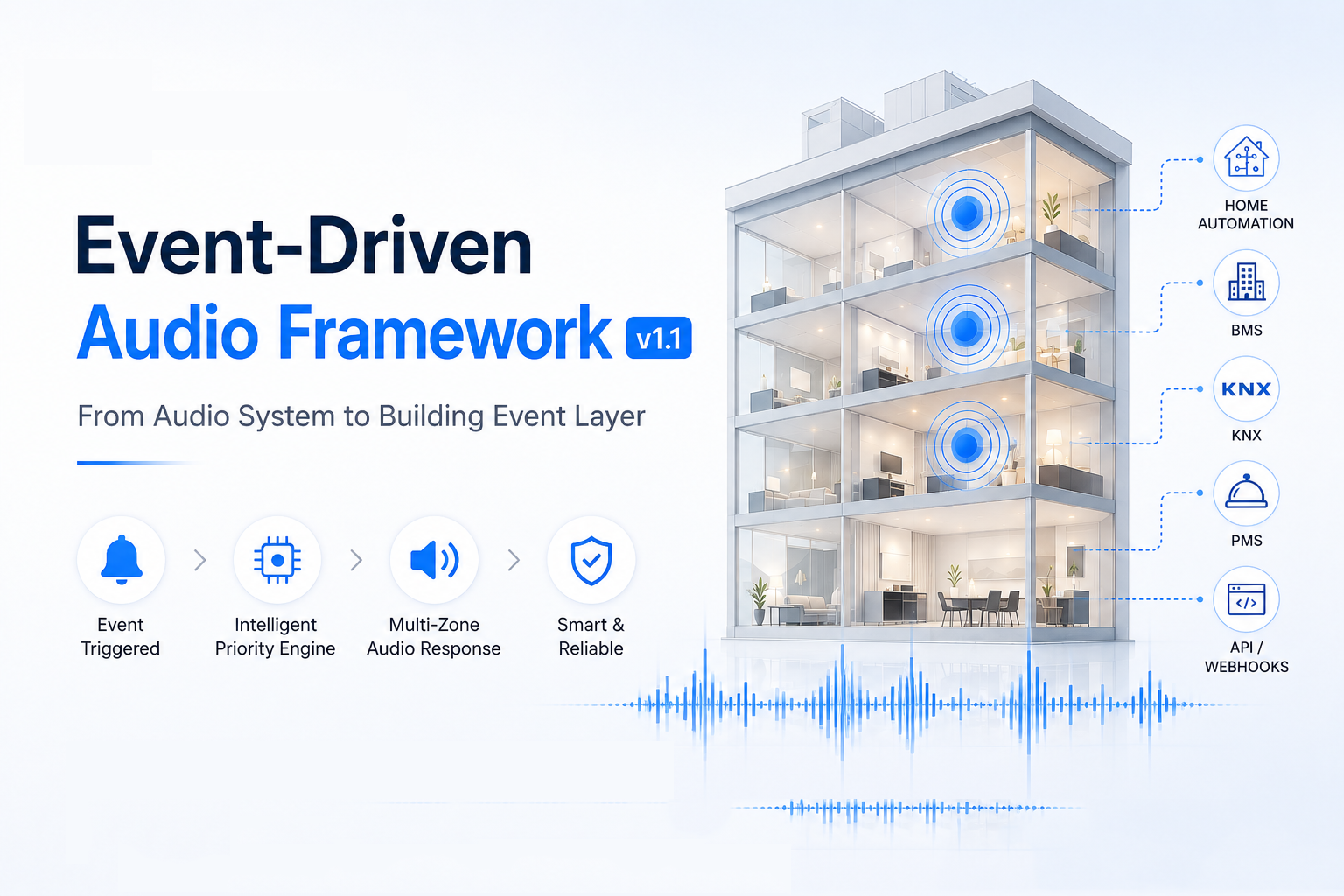
OpenAudio Event-Driven Audio Framework v1.1
From Audio System to Building Event Layer
Modern smart buildings are no longer defined by isolated subsystems. Instead, they are evolving into interconnected environments where lighting, HVAC, access control, and media systems respond dynamically to real-world events.
Audio is increasingly becoming one of the most important real-time output layers in this ecosystem.
OpenAudio’s Event-Driven Audio Framework introduces a new architecture that transforms traditional multi-room audio systems into a real-time event response layer for smart buildings and hospitality environments.
1. From Playback Systems to Event Systems
Traditional audio systems are built around manual control:
- Play / Pause / Volume
- Source selection
- Zone grouping
In contrast, event-driven architecture introduces a new model:
- External system generates an event
- Audio system interprets event context
- Priority engine determines response
- Zones execute dynamic audio actions
2. Event-Based Architecture Model
A typical event flow is structured as:
External System
→ Event Trigger
→ OpenAudio Event Engine
→ Priority Decision Layer
→ Multi-Zone Audio Execution
Supported event sources include:
- Home Automation Platforms
- Building Management Systems (BMS)
- KNX Networks
- Property Management Systems (PMS)
- Custom API / Webhooks
3. Event Types Supported
The framework is designed for real-world operational scenarios:
- Doorbell & Entry Events
- Security Alerts
- Fire & Emergency Broadcasts
- TTS Voice Announcements
- Hospitality Service Requests
- Scheduled Messaging
- Occupancy-Based Events
4. Priority-Based Audio Intelligence
OpenAudio introduces a structured priority model:
Emergency Broadcast → Highest Priority
Security Alert → High Priority
Doorbell Event → Medium Priority
TTS Announcement → Medium Priority
Background Music → Low Priority
This ensures critical events always override non-critical playback while maintaining seamless recovery of previous states.
5. Audio State Preservation
Unlike traditional systems, Event-Driven Audio maintains:
- Playback position
- Source state
- Zone grouping state
- Streaming session continuity
After event completion, the system automatically restores previous audio state without manual intervention.
6. Application Scenarios
This architecture enables new use cases across industries:
Hospitality
- Room service announcements
- Guest notifications
- Emergency broadcasts
- Event-based messaging
Smart Buildings
- Security alerts
- Occupancy-driven audio
- Facility announcements
Residential
- Doorbell and intercom integration
- Automation-triggered voice alerts
- Multi-room coordination
7. System Positioning
This framework redefines OpenAudio from:
Multi-room audio system
to:
Event-driven audio infrastructure layer for smart environments
Conclusion
As buildings become more intelligent, audio is no longer just a playback system.
It becomes an active participant in real-time building communication.
The OpenAudio Event-Driven Audio Framework establishes a foundational layer for this transformation.
For more information, visit www.openaudio.io.