For many years, audio systems in hospitality projects were treated as isolated AV components, often added during the final stages of project delivery. Background music systems for guest rooms, restaurants, lounges, and conference spaces typically operated independently, with little connection to wider building infrastructure.
Today, that model is rapidly changing.
Across modern hospitality developments, distributed audio systems are increasingly becoming part of the intelligent building layer itself, converging with automation, networking, energy management, and guest experience technologies. Audio infrastructure is no longer viewed simply as an entertainment feature, but as a core operational and experiential component within smart building design.
The Rise of Experience-Driven Hospitality
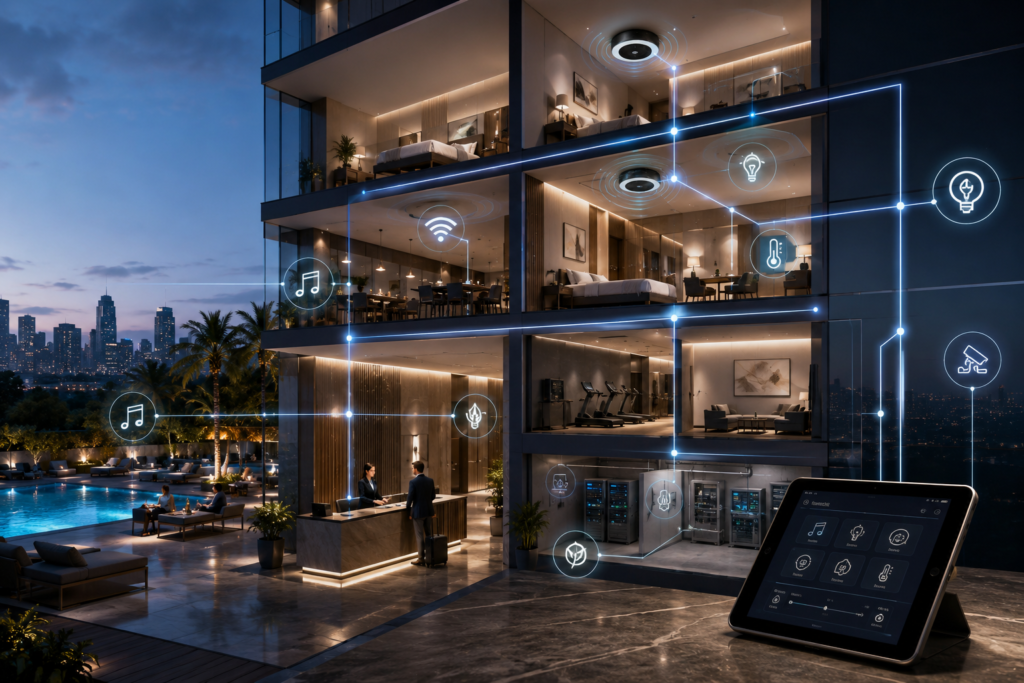
Hospitality operators are under growing pressure to create immersive, personalized, and operationally efficient environments. Lighting, climate control, occupancy sensing, digital signage, and background audio are now expected to function together as part of a unified experience ecosystem.
As a result, distributed audio is evolving far beyond traditional music playback. In luxury hospitality environments especially, background music has become part of spatial design itself.
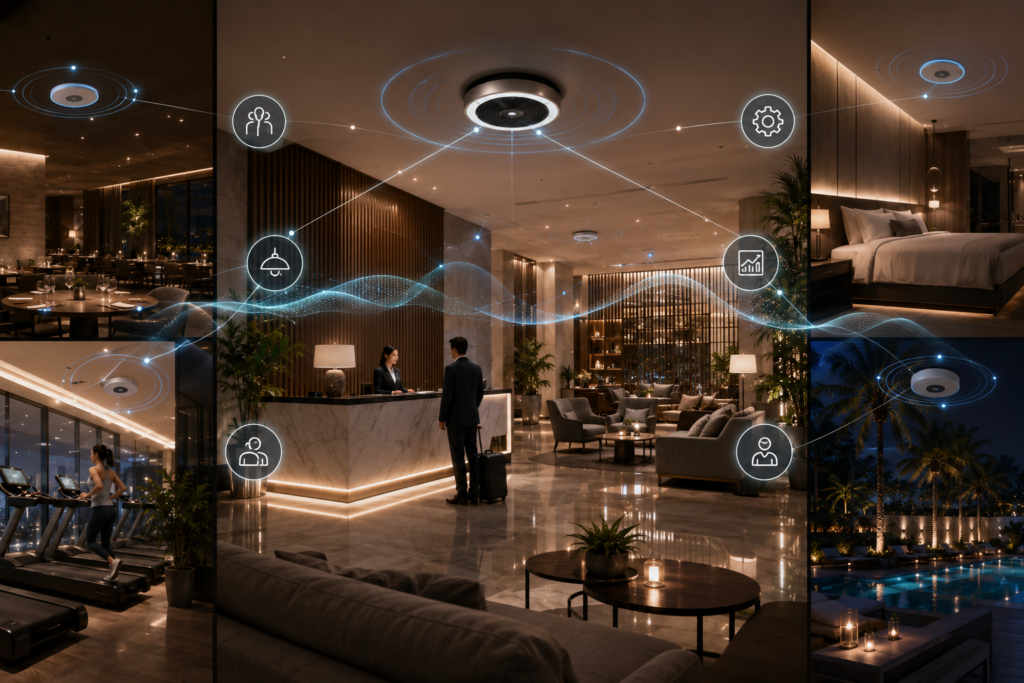
For example, in a modern five-star hotel, restaurants may automatically transition to brighter music and environmental settings during breakfast hours, while evening dining areas shift toward warmer lighting and softer audio profiles. Conference areas may dynamically mute adjacent public-zone audio during meetings, while guest rooms can trigger personalized music and environmental scenes upon occupancy.
In this context, audio is no longer simply a “music playback system,” but an integrated component of atmosphere, operational intelligence, and brand identity.
From Standalone AV to Integrated Infrastructure
Historically, many hospitality audio deployments relied on fragmented architectures involving independent zone amplifiers, localized streaming devices, disconnected control systems, and manually configured routing.
While functional, these approaches often created operational complexity, inconsistent user experiences, and long-term maintenance challenges.
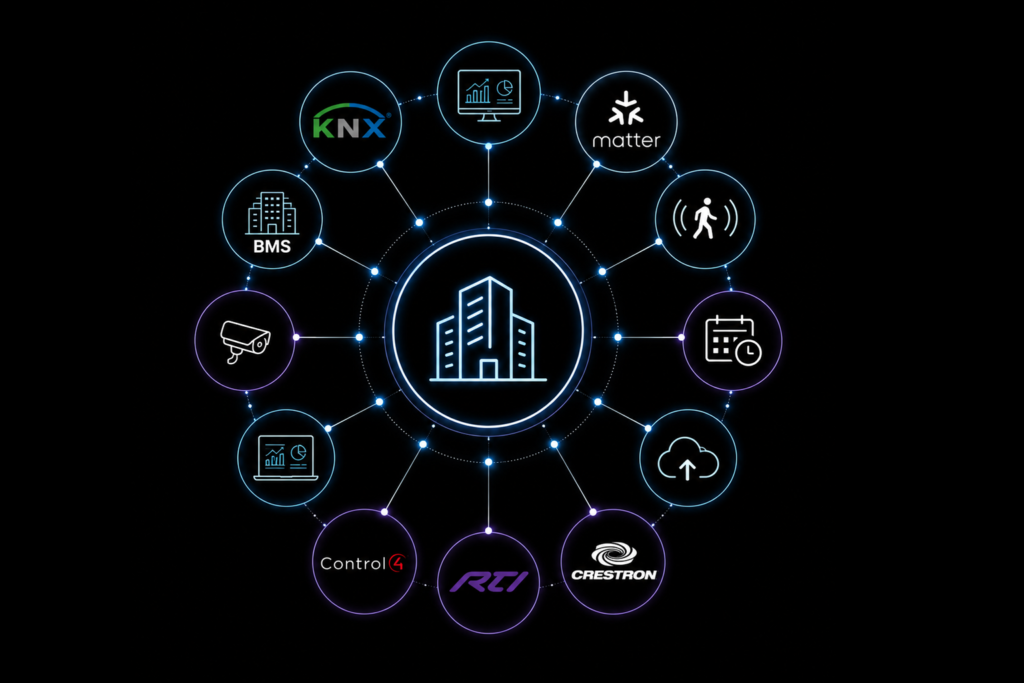
Modern hospitality projects are instead moving toward centralized and network-based distributed audio architectures. These systems increasingly integrate directly with:
- Building Management Systems (BMS),
- KNX automation platforms,
- Matter-enabled ecosystems,
- occupancy sensors,
- scheduling systems,
- and centralized monitoring platforms.
In North America and luxury residential hospitality projects, platforms such as Control4, RTI, and Crestron are also becoming increasingly integrated into hospitality and mixed-use environments rather than remaining purely residential automation systems.
This convergence allows hospitality operators to manage audio dynamically based on schedules, occupancy conditions, and guest scenarios. Audio is no longer functioning independently; it is becoming part of the building logic itself.
Centralized Architecture Is Returning
The hospitality sector is also seeing renewed interest in centralized AV and audio architectures.
For several years, decentralized wireless devices dominated many commercial deployments because of simplicity and low upfront cost. However, as hospitality projects scale in complexity, operators are rediscovering the advantages of centralized infrastructure:
- simplified maintenance,
- centralized monitoring,
- scalable zoning,
- reduced hardware fragmentation,
- and improved long-term reliability.
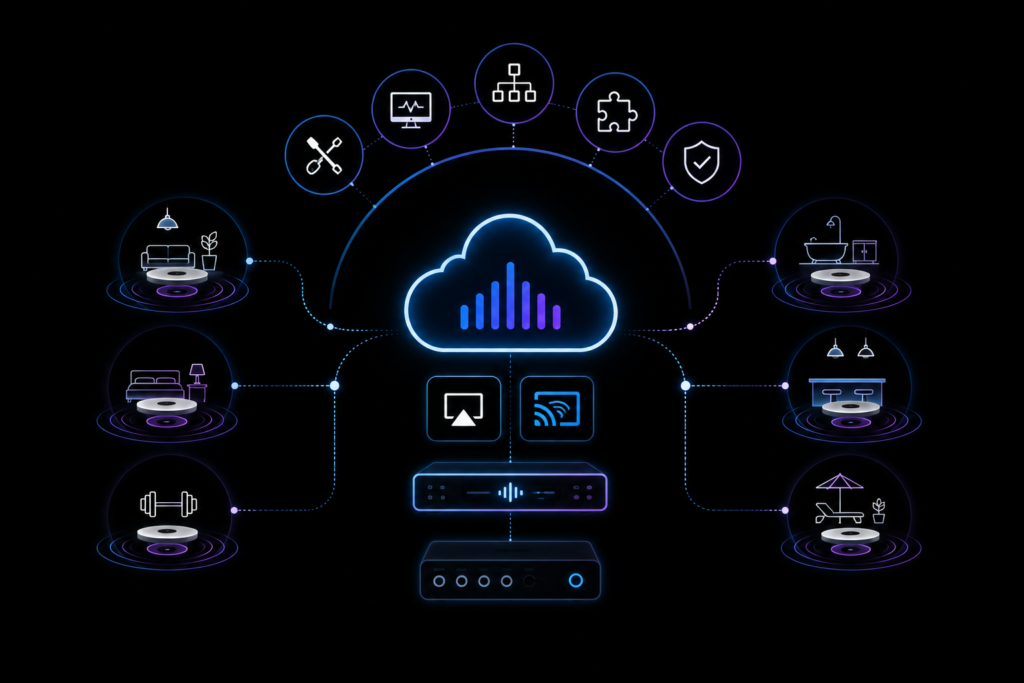
This does not mean abandoning modern streaming technologies. Instead, the market is increasingly moving toward hybrid architectures combining AirPlay and Google Cast streaming, network-based audio distribution, centralized DSP, automation integration, and cloud-based management.
A practical example is the rise of multi-stream SaaS platforms, where a single account can deliver dozens of concurrent streams to different zones. This significantly reduces the number of devices, subscriptions, and configuration workloads, simplifying both deployment and long-term operation.
The Growing Importance of Interoperability
Another major driver behind this convergence is interoperability.
Hospitality developers and system integrators increasingly prefer technologies that integrate across multiple platforms rather than operate within closed ecosystems. Open standards such as KNX IoT, Matter, IP-based control systems, and API-driven architectures are becoming increasingly important in hospitality and mixed-use developments.
As hospitality environments become more software-defined and data-oriented, audio systems are increasingly expected to communicate with occupancy management systems, energy platforms, centralized dashboards, mobile applications, and third-party automation ecosystems.
The ability for distributed audio infrastructure to integrate into broader smart building logic is quickly becoming a strategic advantage rather than a technical luxury.
Looking Forward
The convergence of distributed audio and smart building infrastructure is still in its early stages, but the direction is becoming increasingly clear.
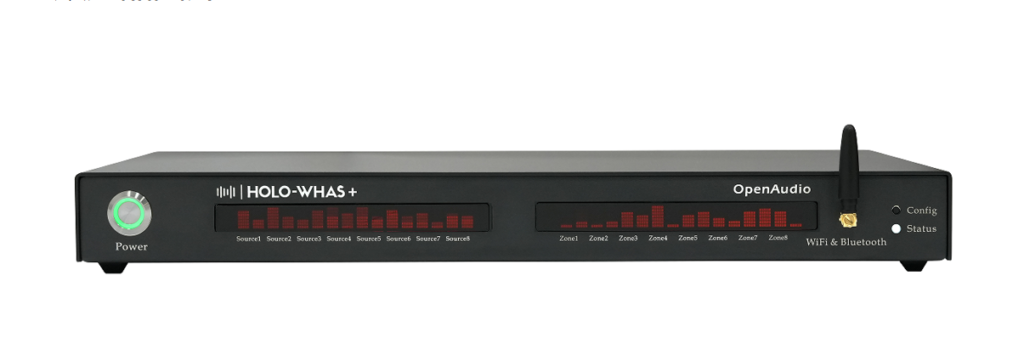
In modern hospitality projects, audio is evolving from a standalone subsystem into an integrated layer within the intelligent building ecosystem. The future of hospitality technology will not be defined by isolated devices, but by interoperable systems working together to create seamless operational and guest experiences.
As hospitality environments continue becoming smarter, more connected, and increasingly experience-driven, distributed audio infrastructure will likely play a far more strategic role than ever before — not simply delivering sound, but helping shape the intelligent spaces of the future.
For more information, please visit www.openaudio.io