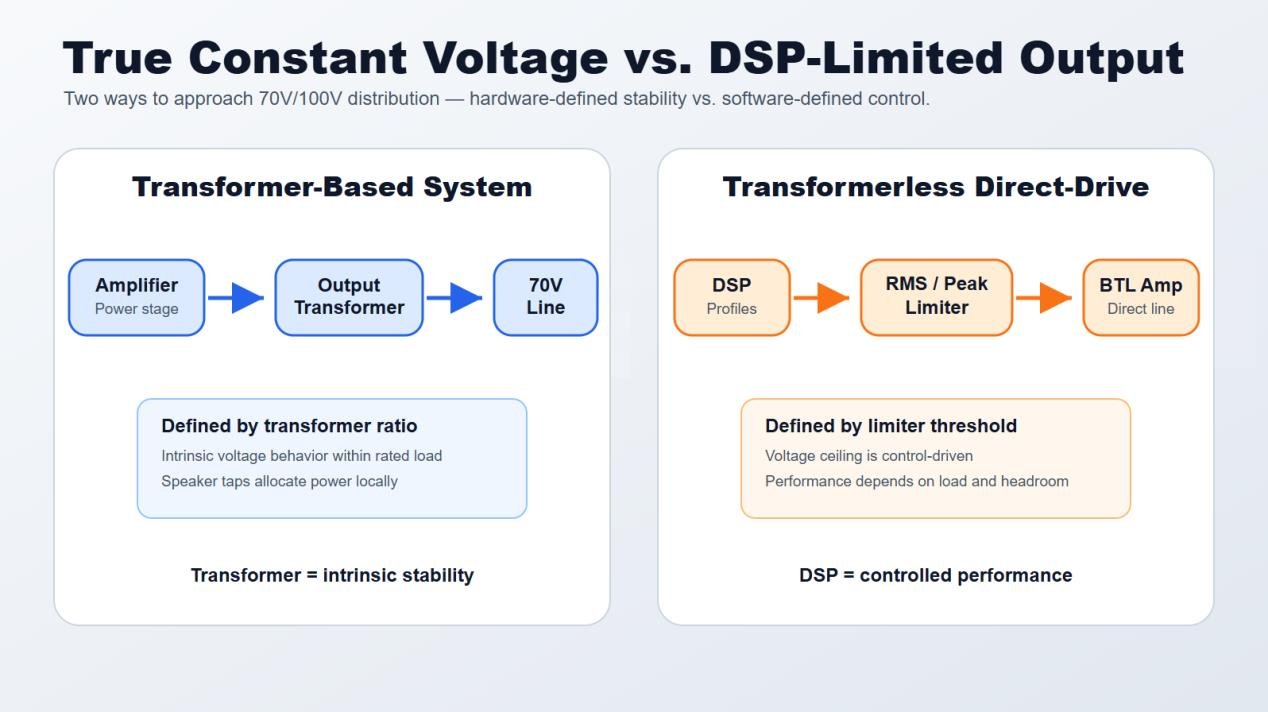
A Practical Engineering Perspective on “True Constant Voltage”
Introduction
Commercial distributed audio has long relied on 70V/100V line systems for efficient power delivery over long cable runs and across many loudspeakers. Traditionally, these systems used output transformers to create a high-voltage, low-current distribution network that behaves close to a constant-voltage source.
In the past decade, a different approach has gained traction: transformerless (direct-drive) Hi-Z amplifiers, often combined with DSP. These designs promise higher efficiency, smaller size, and tighter integration with modern multi-zone platforms.
This article clarifies the engineering differences between the two approaches—where they behave similarly, where they diverge, and what that means in real projects.
1. What “Constant Voltage” Actually Means
In a classic 70V/100V system:
- The amplifier output is stepped up via a transformer
- The line operates at high voltage, low current
- Each loudspeaker has its own tap transformer
- The system approximates a constant-voltage distribution
Implication:
Adding or removing speakers does not significantly change the line voltage (within rated limits). Power is allocated locally by each speaker’s tap.
2. Two Architectures, One Goal
A) Transformer-Based (Conventional)
- Output transformer on the amplifier
- Per-speaker transformers (tap selection)
- High source impedance behavior
- Passive, physics-driven distribution
B) Transformerless (Direct-Drive + DSP)
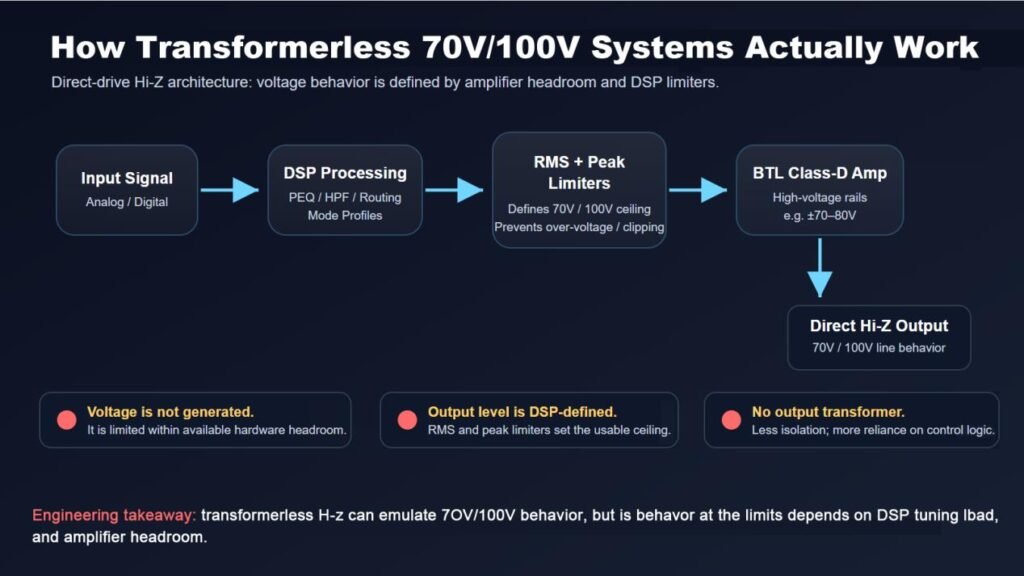
- High-voltage rails (e.g., ±70–80V)
- Bridge-tied load (BTL) to reach required swing
- DSP-defined voltage ceiling (RMS + peak limiters)
- Low output impedance (typical Class D behavior)
Key idea:
Both aim to deliver “70V/100V behavior,” but one relies on hardware characteristics, the other on control strategy.
3. Where the Differences Matter
3.1 Load Variations
Transformer-based:
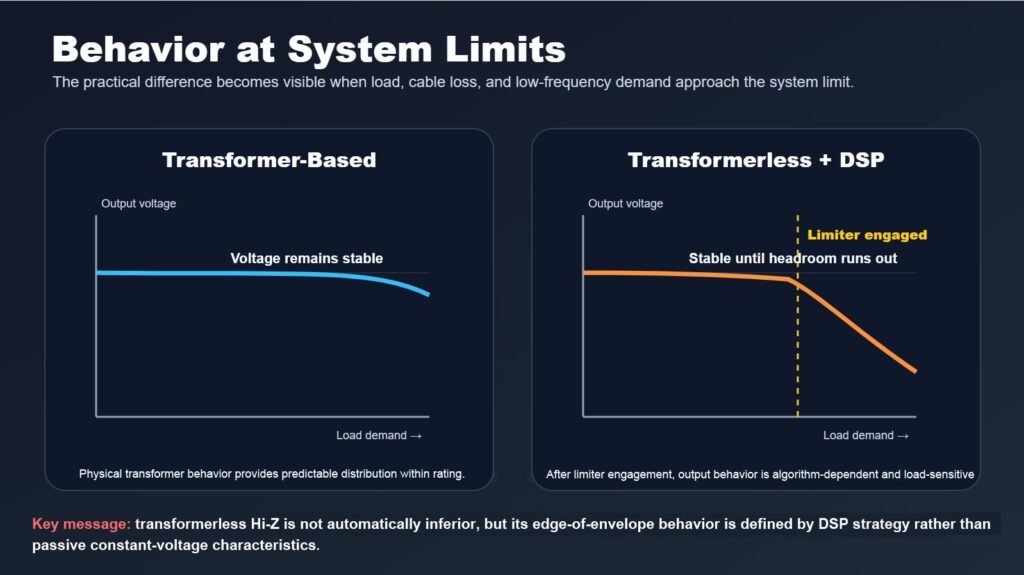
- Line voltage remains relatively stable as load changes
- Each speaker draws power independently via its tap
Transformerless:
- Output is low impedance; voltage is regulated by DSP limiters
- As total load increases:
- The system reaches its limiter sooner
- Effective headroom reduces
Engineering takeaway:
Performance near maximum load is more sensitive to system configuration in transformerless designs.
3.2 Low-Frequency Behavior
Low frequencies demand higher current.
Transformer-based:
- Transformer characteristics naturally limit LF energy
- Some magnetic compression at extremes
Transformerless:
- Typically uses high-pass filtering (HPF) and limiters
- LF response is policy-driven (DSP) rather than intrinsic
Engineering takeaway:
LF performance is actively managed in transformerless systems.
3.3 Clipping and Limiting
Transformer-based:
- Saturation and compression are mostly analog/physical
- Behavior is gradual and device-dependent
Transformerless:
- Dominated by DSP limiters (RMS + peak)
- Behavior depends on attack/release, knee, and tuning
Engineering takeaway:
Sound at the limit is algorithm-defined vs. material-defined.
3.4 System Isolation
Transformer-based:
- Each speaker is partially isolated via its transformer
- Faults tend to be localized
Transformerless:
- Entire line is directly driven by the amplifier
- Protection is centralized (amplifier + DSP)
Engineering takeaway:
System robustness depends more on global protection strategy.
3.5 Line Loss and Distribution
Both architectures benefit from high-voltage distribution (lower current → lower I²R loss).
However:
- Transformer systems are inherently optimized for distribution
- Transformerless systems rely on:
- Careful load calculation
- Conservative headroom
- DSP safeguards
4. What Transformerless Systems Do Very Well
Despite the differences, modern transformerless designs offer clear advantages:
- Higher efficiency (no transformer losses)
- Reduced size and weight
- Flexible DSP control (limiters, EQ, zoning)
- Integration with networked/multi-room systems
- Cost and thermal benefits at system level
In typical operating ranges, they can closely emulate constant-voltage behavior.
5. Where Traditional Systems Still Excel
Transformer-based systems remain strong in:
- Predictable behavior under unknown or changing loads
- Passive robustness (less dependence on tuning)
- Standards familiarity in legacy installations
- Simplified design assumptions for large distributed systems
6. A More Accurate Way to Describe Both
Rather than “real” vs. “fake,” a better engineering description is:
- Transformer-based systems provide
→ intrinsic voltage stability through hardware characteristics - Transformerless systems provide
→ controlled voltage behavior through DSP and amplifier design
Both approaches are valid—they simply optimize different constraints.
7. Comparison: Transformer vs. Transformerless 70V/100V Systems
| Category | Transformer-Based System | Transformerless (Direct-Drive + DSP) |
| Output Principle | High source impedance via transformer | Low impedance amplifier with DSP-controlled limits |
| Voltage Behavior | Intrinsically stable (hardware-defined) | Controlled via DSP (RMS / peak limiting) |
| Response to Load Changes | Largely insensitive within rated load | More sensitive near maximum load |
| Power Distribution | Per-speaker transformer taps (local allocation) | Centralized power delivery from amplifier |
| Low-Frequency Behavior | Naturally limited by transformer characteristics | Managed via DSP (HPF + limiter) |
| Clipping / Limiting | Magnetic saturation (gradual, passive) | DSP limiter (attack/release dependent) |
| System Isolation | Each speaker partially isolated | Shared output, centralized protection |
| Efficiency | Lower (transformer losses) | Higher (no transformer) |
| Size / Weight | Larger and heavier | Compact and lightweight |
| Flexibility | Limited (fixed hardware behavior) | High (DSP configurable) |
| System Design Complexity | Simpler assumptions | Requires careful load and tuning design |
| Behavior at System Limits | Predictable, hardware-driven | Depends on DSP tuning and headroom |
| Integration Capability | Limited | Strong (multi-zone, networked audio) |
8. Representative Examples by Architecture
| Architecture | Representative Examples* |
| Transformer-Based 70V/100V | TOA Corporation traditional PA amplifiers; Crown Audio CTs series; AtlasIED legacy constant-voltage amps; OpenAudio HOLOWHAS |
| Transformerless (Direct-Drive + DSP) | Bose PowerShare PS604; QSC CXD / SPA series; Powersoft Mezzo / Quattrocanali; OpenAudio CAMP |
Examples are provided for illustrative purposes to show different architectural approaches. Product capabilities and implementations may vary by model and configuration.
Conclusion
The evolution from transformer-based to transformerless 70V/100V systems reflects a broader shift in audio engineering:
- From passive, physics-driven distribution
- To active, software-defined control
Understanding the distinction is not about choosing sides—it is about designing the right system for the right application.
One-Line Summary
Transformer systems achieve constant voltage by design; transformerless systems achieve it by control.
For more details, please visit the official OpenAudio website: www.openaudio.io.