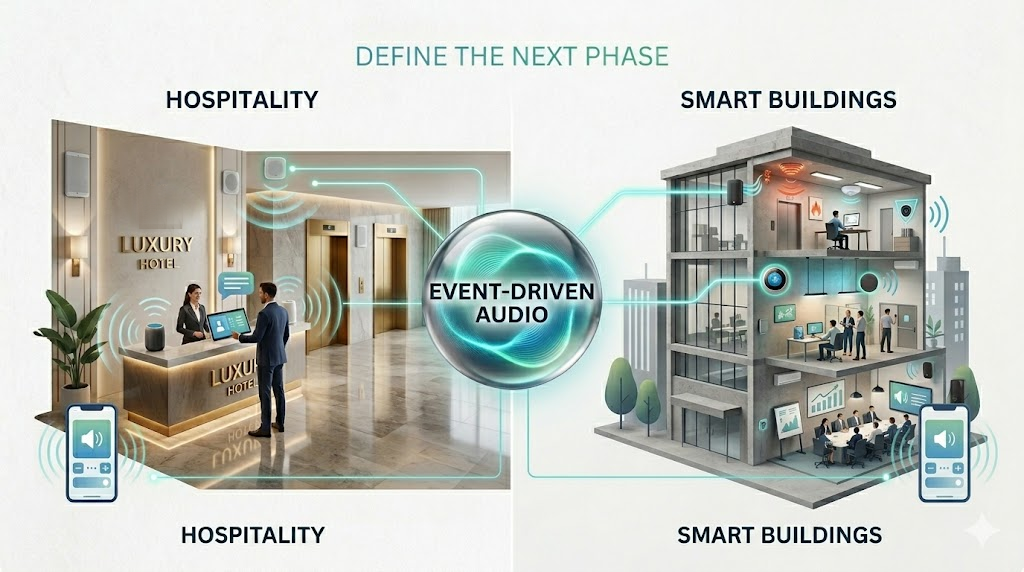
Why Event-Driven Audio Will Define the Next Phase of Hospitality and Smart Buildings
The evolution of smart buildings and hospitality environments is no longer driven by standalone systems. Instead, the industry is shifting toward integrated, event-responsive infrastructures where systems communicate in real time.
Among these systems, audio is emerging as one of the most critical real-time experience layers.
1. The Limitation of Traditional Audio Systems
Conventional multi-zone audio systems are built for:
- Background music distribution
- Manual source control
- Static zone management
However, they are not designed to respond to:
- Operational events
- Guest interactions
- Safety alerts
- System-wide automation triggers
This creates a gap between building intelligence and user experience.
2. The Rise of Event-Driven Infrastructure
Modern smart environments rely on event-based coordination between systems:
- KNX automation events
- PMS hotel operations
- BMS safety and infrastructure systems
- Access control systems
- IoT sensor networks
Audio is increasingly required to act as a real-time response layer within this ecosystem.
3. Audio as an Operational Communication Layer
Event-driven audio enables buildings to communicate dynamically:
Instead of:
- Static background music
Systems can now deliver:
- Contextual announcements
- Priority alerts
- Location-based messaging
- Guest experience enhancements
This transforms audio from entertainment into operational infrastructure.
4. Hospitality Use Case Transformation
In hospitality environments, event-driven audio enables:
Guest Experience Layer
- Check-in and welcome messages
- Personalized announcements
- Service notifications
Operational Layer
- Room service alerts
- Staff coordination messaging
- Event scheduling notifications
Safety Layer
- Fire and emergency broadcasts
- Evacuation instructions
- Security alerts
5. Integration with Smart Building Ecosystems
Event-driven audio systems must integrate seamlessly with:
- KNX networks
- Property Management Systems (PMS)
- Building Management Systems (BMS)
- Smart home platforms
- API-based hospitality applications
This ensures audio becomes a native part of building intelligence rather than an external subsystem.
6. Business Impact
The introduction of event-driven audio systems creates measurable value:
- Improved operational efficiency
- Enhanced guest experience consistency
- Increased revenue from event spaces (MICE)
- Stronger brand experience control
- Reduced manual operational workload
7. Strategic Shift
The industry is moving from:
Audio as a product
to
Audio as a system-level infrastructure layer
This shift positions event-driven audio as a core component of next-generation smart buildings.
Conclusion
Event-driven architecture represents the next logical evolution of audio systems in hospitality and smart buildings.
It aligns audio with the broader intelligence layer of modern infrastructure, enabling systems to respond dynamically, intelligently, and contextually to real-world events.
For more information, visit www.openaudio.io.