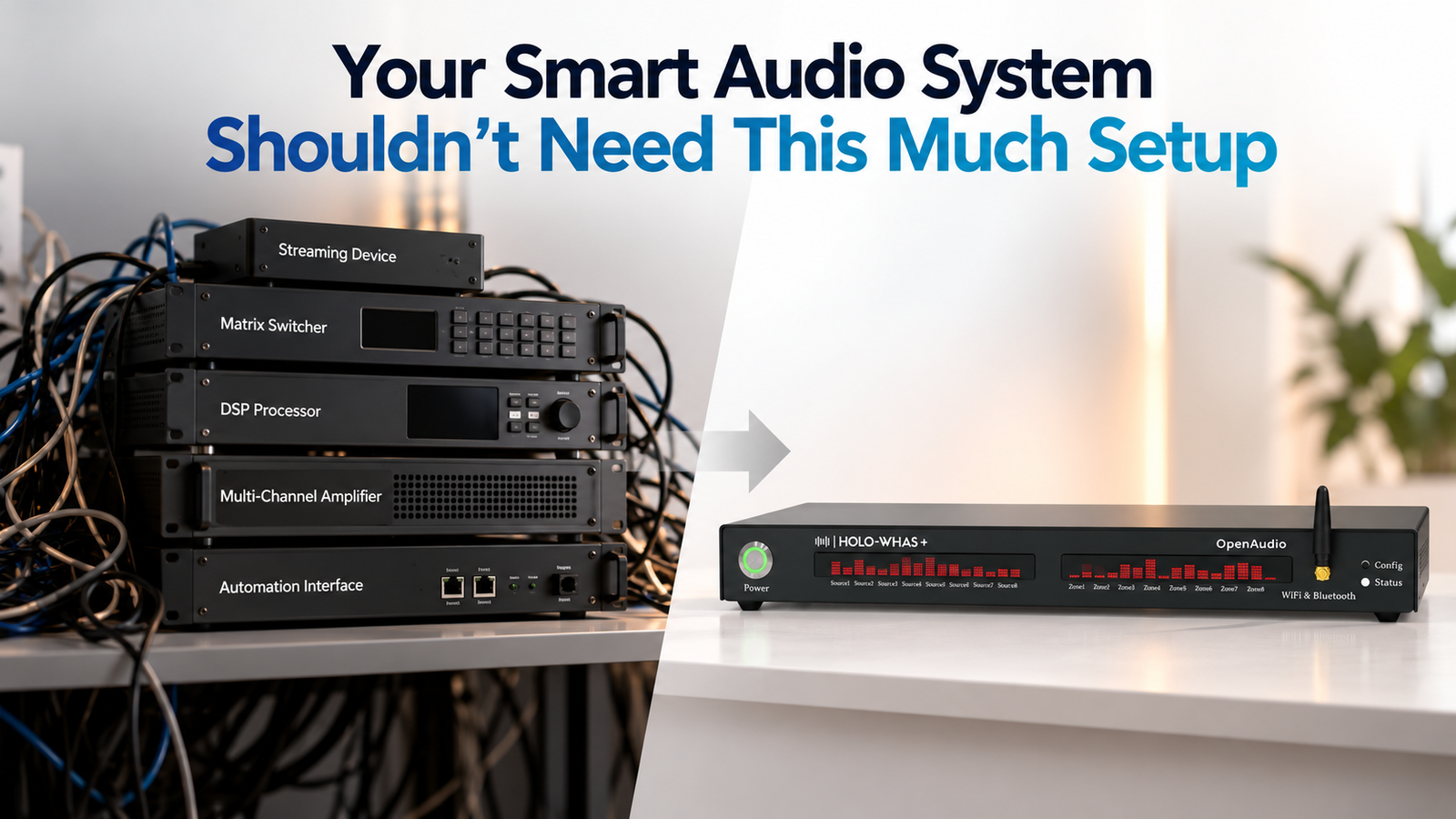
Your Smart Audio System Shouldn’t Need This Much Setup
Streaming, amplification, DSP, matrix routing and automation — why should they require a rack full of separate boxes?
Multi-zone audio has become increasingly capable.
The way we listen to music has changed. AirPlay 2, Google Cast, Spotify Connect and high-resolution streaming have become part of everyday life. At the same time, smart homes and buildings increasingly expect audio to work alongside lighting, HVAC, shading, room controls and other systems.
Yet behind the scenes, many multi-zone audio systems are still surprisingly complicated.
A typical installation may require separate streaming devices, matrix switchers, DSP processors, multi-channel amplifiers and automation interfaces — all connected together, configured separately and expected to behave like one system.
Why should multi-zone audio need this much setup?
We think it shouldn’t.
One Audio Platform Instead of a Collection of Boxes
The OpenAudio HOLOWHAS platform was designed around a simple idea:
Bring the core components of a modern multi-zone audio system together into one integrated platform.
Instead of building an audio system from multiple independent devices, the OpenAudio HOLO-WHAS platform combines network streaming, audio routing, DSP and control within a single architecture, while providing flexible amplification options for different project requirements.
An 8-zone HOLOWHAS Platform can provide:
- Up to 8 independent AirPlay 2 receivers
- Up to 8 independent Google Cast receivers
- Spotify Connect
- Qobuz Connect, supporting high-resolution streaming up to 192 kHz / 24-bit
- 8-zone audio distribution
- Up to 16 channels of amplification
- Built-in DSP and matrix routing
- HDMI ARC, optical, analog and network audio sources
- Integration with KNX, Control4, RTI, Home Assistant and Web API
Instead of asking how five different products can be made to work together, the installer starts with one audio platform.
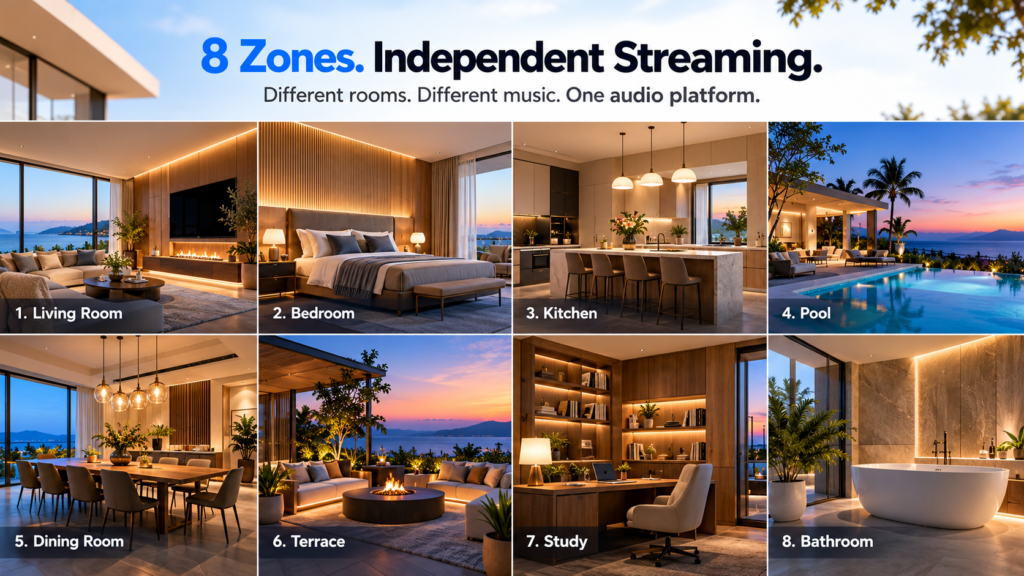
Eight Rooms Shouldn’t Have to Share One Streaming Experience
Streaming is often where the difference between a traditional multi-zone amplifier and a modern audio platform becomes obvious.
Imagine an eight-zone villa.
Someone in the living room wants to use AirPlay 2. Another person in the bedroom wants Google Cast. Someone by the pool wants to listen through Spotify Connect.
These shouldn’t have to be treated as one streaming session.
OpenAudio is designed to provide multiple independent streaming endpoints across the system, allowing different rooms to access different content while still operating as part of the same multi-zone audio infrastructure.
And when several rooms should play together, they can.
That makes the architecture suitable not only for whole-home audio, but also for luxury villas, suites and other environments where independent listening and grouped playback need to coexist.
DSP and Matrix Routing Should Be Part of the System
Getting music into a room is only part of the job.
Different spaces have different acoustic requirements. A bedroom, kitchen, outdoor terrace, restaurant and hotel lobby should not necessarily use the same audio configuration.
That is why OpenAudio integrates DSP and flexible matrix routing directly into the platform.
Installers can manage audio sources, zones and system behavior without adding another external processor simply to perform everyday audio routing and tuning tasks.
The result is a cleaner architecture with fewer devices and fewer points of integration.
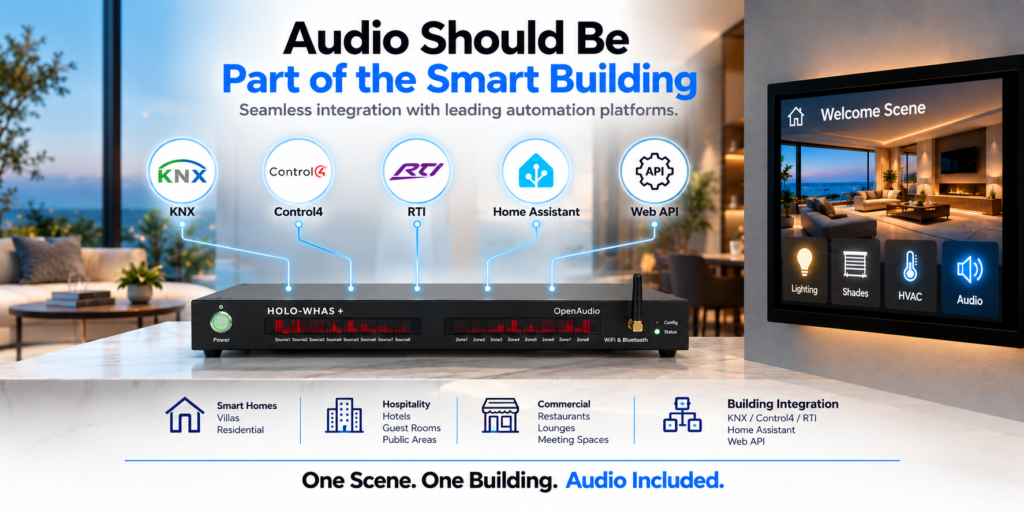
Smart Audio Should Be Part of the Smart Building
There is another problem with many audio systems: they are connected to a smart building, but they are not really part of the smart building.
Lighting can respond to scenes.
Shades can respond to occupancy.
HVAC can respond to room status.
Why should audio remain isolated?
OpenAudio HOLOWHAS Platform supports integration with platforms including KNX, Control4, RTI and Home Assistant, as well as API-based integration with third-party systems.
With native KNX integration, for example, the building control system can interact directly with audio functions such as zone control, source selection, volume and playback status.
This makes audio another controllable part of the building infrastructure rather than a standalone system sitting beside it.
A single scene could prepare the lighting, temperature, shades and audio for a room.
That is what smart-building integration should look like.
From Homes to Hospitality and Commercial Spaces
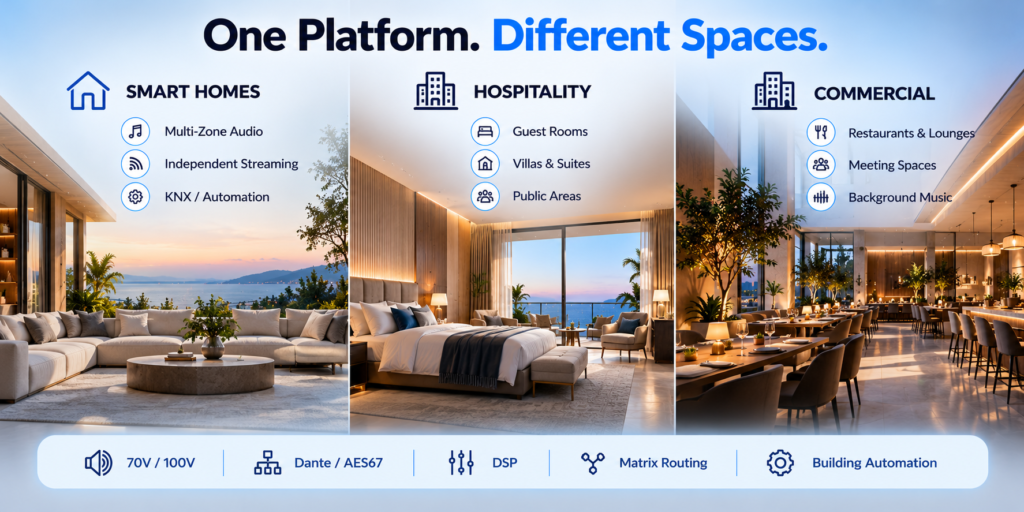
The same principle extends beyond residential installations.
Hotels, restaurants, lounges, spas, meeting spaces and other commercial environments often require more complex audio distribution — including larger speaker systems and integration with wider building infrastructure.
The OpenAudio ecosystem can form part of these systems through support for technologies and architectures including:
70V/100V distributed audio, Dante/AES67 network audio, DSP, matrix routing and building automation integration.
This allows the same platform philosophy to extend from a private residence to villas, guest rooms, public areas and commercial background-music systems.
The scale changes.
The underlying idea does not.
The OpenAudio Product Ecosystem
From HOLOWHAS multi-zone streaming amplifiers and 1-zone streaming amplifier solutions, to wireless speakers and 70V/100V integration products, OpenAudio provides a flexible audio ecosystem for smart homes, hospitality and commercial applications.
8-zone Multi-Room Streaming Amplifier HOLOWHAS Series:
HOLOWHAS, HOLOWHAS Ultra, HOLOWHAS Ultra-GC , HOLOWHAS Plus, HOLOWHAS Plus GC, HOLOWHAS Max
1-Zone Streaming Amplifier Streamer Solutions:
HoloHome Streamer, HoloHome Streamer Plus, StreamerAmp Pro
70V/100V Integration Solution Low-Z to High-Z Transformer Module:
Fewer Boxes. Fewer Connections. Less Complexity.
Every additional device in an AV system brings something else with it.
Another power supply.
Another network connection.
Another configuration interface.
Another set of cables.
Another integration point.
And another potential point of failure.
There will always be projects where dedicated processors, amplifiers or specialist equipment make sense. The goal isn’t to eliminate every external component.
The goal is to stop adding components when the system doesn’t need them.
By bringing streaming, amplification, DSP, matrix routing and automation integration together, OpenAudio can simplify the core architecture before additional equipment is introduced.
Multi-Zone Audio Should Feel Like One System
Users don’t care how many boxes are installed in the rack.
They simply want to choose a room, choose their music and listen.
Integrators, meanwhile, need a system that is flexible enough to design, deploy, integrate and support across different projects.
Those two requirements shouldn’t be in conflict.
Modern multi-zone audio should provide sophisticated technology behind the scenes while making the overall system simpler to build and easier to use.
Streaming. Amplification. DSP. Matrix. Automation.
They don’t always need to be separate systems.
One Platform. Multiple Zones. Less Complexity.
OpenAudio HOLOWHAS — Multi-Zone Audio Infrastructure for Smart Homes, Hospitality and Commercial Spaces.
Please visit the official website www.openaudio.io